
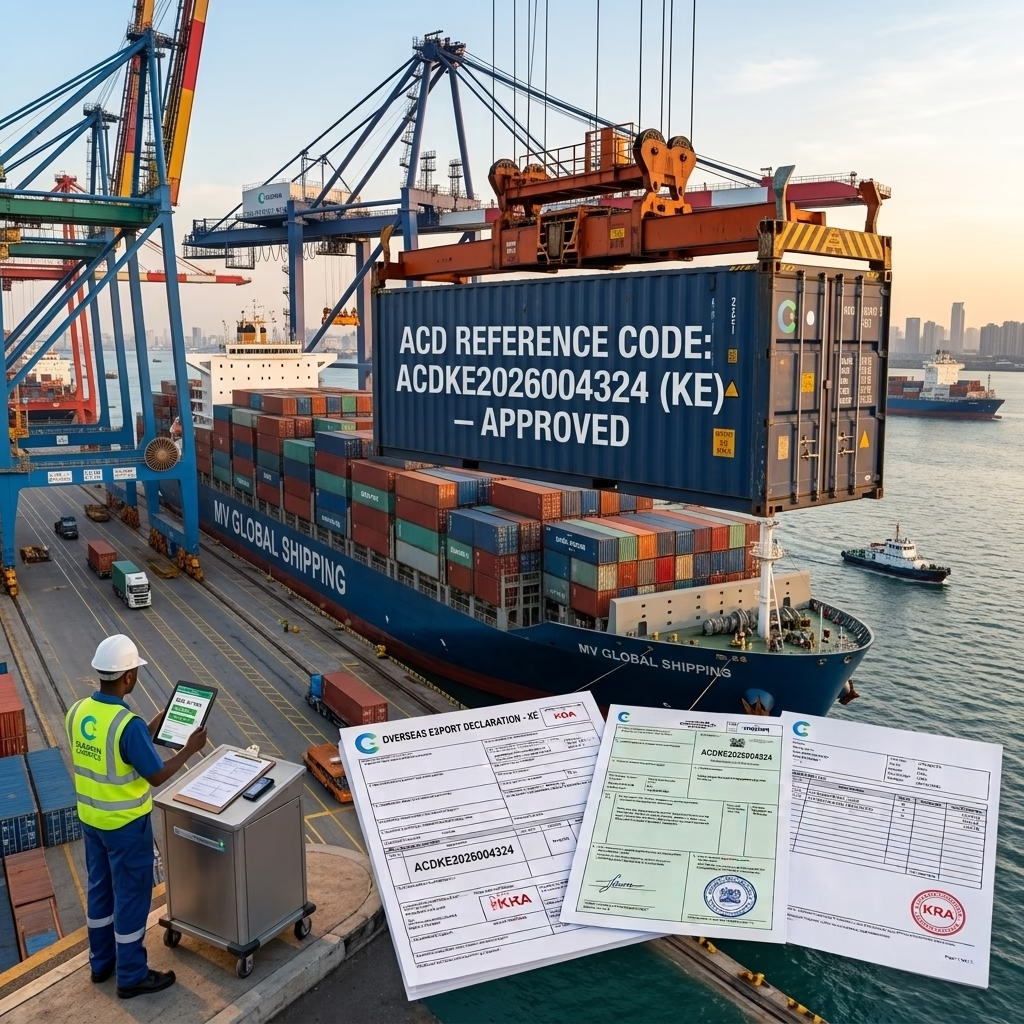
Advance Cargo Declaration Kenya compliance is no longer optional for anyone shipping containerised cargo by sea — it’s now a hard gate at the port of loading, not a formality handled later at clearance. The Kenya Revenue Authority’s ACD platform went live on 3 August 2026, and since 1 September 2026, shipping lines have been required to validate a shipment’s ACD Reference Code before the container is even allowed onto the vessel. If your business ships by sea into Mombasa, this now sits earlier in your process than anything else you’re used to tracking.
Table of Contents
What the ACD Actually Is
The Advance Cargo Declaration is a mandatory pre-loading declaration for containerised cargo destined for Kenyan ports — also referred to internationally by similar names like CTN, ECTN, BSC, or BESC, terms used for comparable pre-shipment tracking systems in other African countries. It provides KRA with advance information about the cargo, vessel, shipper, and supporting shipment documents before the goods are even loaded, not after they arrive in Kenya.
Once your application is reviewed and approved, the system issues a unique 15-digit alphanumeric ACD Reference Code (in the format ACDKE followed by digits), which must then be endorsed on the final Bill of Lading before your container is loaded at origin.
Why This Is Different From Everything Else You’ve Dealt With
Every other customs requirement most importers know — duty, VAT, the Certificate of Origin, the IDF — gets handled at or before arrival in Kenya, generally by a clearing agent working on the Kenyan side of the transaction. The ACD is different: it’s a loading-stage requirement, meaning it has to be sorted out at the port of origin — in China, India, the UAE, or wherever your supplier is shipping from — before the container ever leaves.
This is a meaningful shift in when compliance responsibility kicks in. It doesn’t replace or change how duty, VAT, IDF, or the RDL are calculated — it’s an additional, earlier checkpoint that has to be cleared first, regardless of whether everything else about your shipment is already in order.
What You Need to Apply
The ACD Platform requires four core documents, submitted by the shipper, exporter, or freight forwarder:
- Draft Bill of Lading
- Commercial Invoice
- Freight Invoice
- Export Declaration
All documents need to be clear and legible, and the draft ACD submission should include full container details and correct HS Codes — another reason accurate classification matters from the very first step of a shipment, not just at Kenyan clearance.
The Step-by-Step Process
- Register and submit your shipping documents through the official ACD Platform at acd.kra.go.ke
- Obtain the ACD Reference Code at the port of loading, before your cargo is loaded onto the vessel
- Add the ACD reference code to the final Bill of Lading — this needs to be finalised and clearly printed before dispatch
- Clear your cargo at customs on arrival in Kenya, using your existing standard clearance documentation alongside the now-endorsed Bill of Lading
Shipping lines and carriers have their own obligations in this chain too — informing shippers of the requirement, requesting the code before issuing the final Bill of Lading, and confirming it’s correctly displayed before proceeding.
What Happens If You Don’t Comply
KRA’s own guidance is direct on this: failure to obtain a valid ACD can result in fines, delays, or rejection of cargo at the port of entry — and in severe cases, seizure or confiscation. From 1 September 2026, carriers are specifically required to validate the ACD Reference Number before loading, meaning containers without one may simply not be loaded at all, or may be rolled over to a later vessel — adding weeks to your timeline before your goods have even left the origin port.
This is a fundamentally different kind of risk than a documentation gap discovered at Kenyan clearance. A missing ACD doesn’t delay your goods at Mombasa — it can stop them from ever leaving the supplier’s country on schedule.
Who’s Exempt
Based on KRA’s published scope, the ACD applies specifically to containerised cargo arriving by sea. Air freight shipments are not covered by this requirement, regardless of the goods being shipped. Bulk cargo, RORO (roll-on/roll-off), and cargo genuinely transiting through Kenya to another destination have their own specific treatment under the scheme — worth confirming directly for your shipment type, since the detailed FAQ scope questions KRA has published suggest this is still being refined in practice.
Why This Hits SMEs Hardest
For thousands of Kenyan traders, wholesalers, and small manufacturers, the traditional pattern has been to engage a clearing agent only once a shipment is already dispatched — pay the supplier, get shipping details, then start thinking about the Kenyan side of clearance as the vessel approaches. The ACD breaks that pattern completely. Compliance now has to begin before your goods leave the supplier’s premises, which means your supplier, your freight forwarder, and your Kenyan-side team all need to be coordinated from the very start of the transaction — not brought in sequentially as the shipment progresses.
This is exactly the kind of shift that rewards importers who already treat clearance as a process that starts at the purchase decision, and penalises those who’ve historically treated it as something that only matters once cargo is already at sea.
Getting Ahead of a Loading-Stage Requirement
Because the ACD has to be resolved at origin, this isn’t something your Kenyan clearing agent can fix after the fact if it’s missed — by the time a gap is discovered, your container may already be sitting at the origin port waiting for the next available vessel. The only way to manage this properly is coordinating with your supplier and freight forwarder on the ACD before the Bill of Lading is finalised.
At Clearon Logistics, this is exactly the kind of requirement we build into our pre-shipment process — confirming with clients and their suppliers that the ACD is in hand before cargo is booked for loading, not discovering a gap once a shipment has already missed its vessel. We keep clients updated at every stage of a shipment, from origin through to Kenyan clearance, and give a clear, honest picture of what a new requirement like this actually means for your specific supply chain.
Shipping a container to Kenya and not sure your ACD is in order? Talk to Clearon Logistics before your Bill of Lading is finalised.
Frequently Asked Questions
When did the ACD requirement come into force? The ACD Platform went live on 3 August 2026 for containerised cargo destined for Kenyan ports. From 1 September 2026, carriers have been required to validate the ACD Reference Number before loading.
Does the ACD apply to air freight? No — based on KRA’s published scope, the requirement applies specifically to containerised cargo arriving by sea, not air freight shipments.
Who is responsible for obtaining the ACD Reference Code? The shipper, exporter, or freight forwarder at the port of loading — this is a responsibility that sits at origin, not with the Kenyan importer or clearing agent on arrival.
What happens if my container is loaded without a valid ACD? Under the current framework, this shouldn’t be possible from 1 September 2026 onward, since carriers are required to validate the code before loading — non-compliant containers risk being rolled over to a later vessel, in addition to potential fines or, in severe cases, seizure at the Kenyan port of entry.
Further Reading
- KRA — Official Advance Cargo Declaration Platform (external, dofollow)
- Kenya Ports Authority — official notices (external, dofollow)
- Related on our blog: Import Declaration Form Kenya: What It Is and Why It Matters
- Related on our blog: Certificate of Origin Kenya Imports: Urgent 2026 Rule Change
- Our service: Clearing and Forwarding Services in Kenya










Leave a Reply