
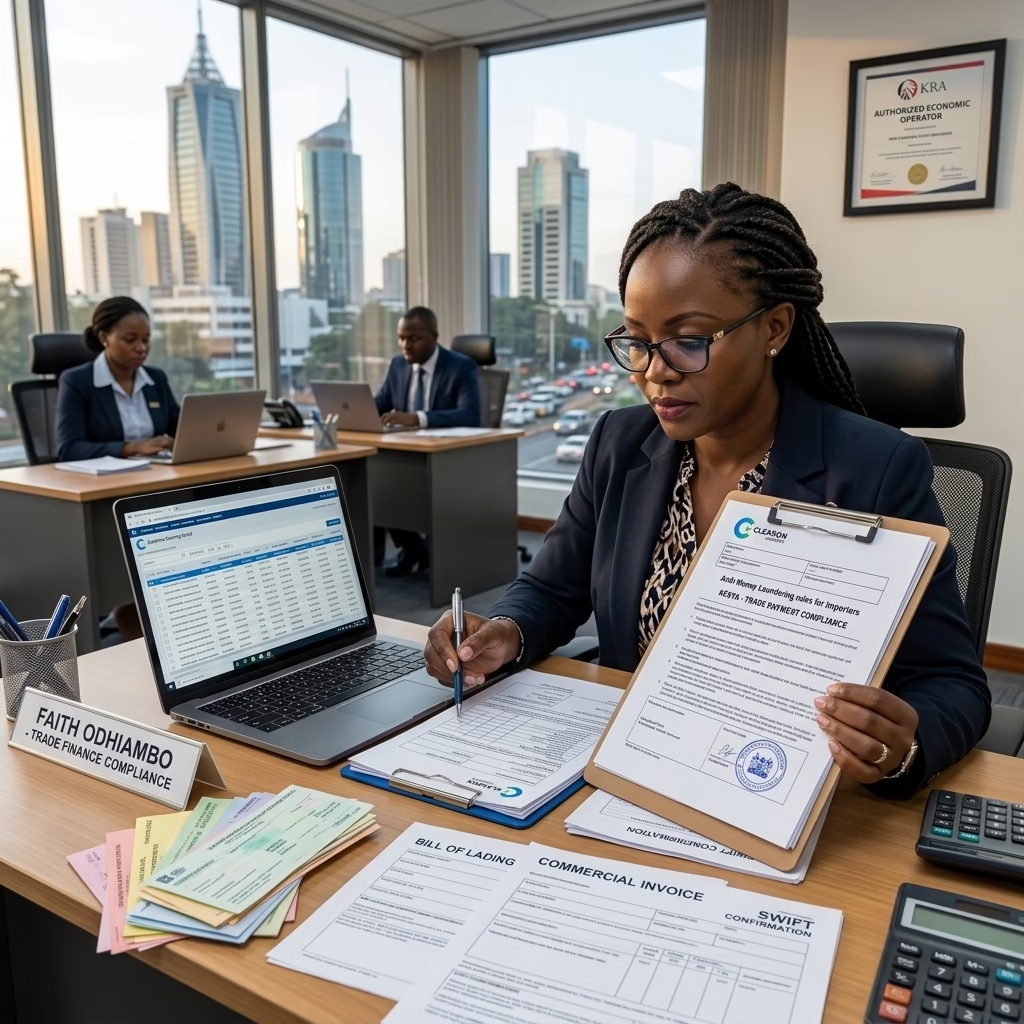
Anti-money laundering rules for high-value importers in Kenya aren’t usually top of mind when you’re focused on customs clearance and duty calculations — but for anyone moving significant sums to pay overseas suppliers, or carrying currency across Kenyan borders, Kenya’s AML framework applies directly, with real reporting thresholds and real penalties for non-compliance.
Table of Contents
The Legal Framework
Kenya’s anti-money laundering regime runs through the Proceeds of Crime and Anti-Money Laundering Act, 2009 (POCAMLA), overseen by the Financial Reporting Centre (FRC), with the Central Bank of Kenya as the primary supervisor for banks and payment service providers specifically. “Reporting institutions” under this framework — a category covering banks, fintechs, lawyers, and accountants — are legally obligated to apply customer due diligence, monitor transactions, and file reports under specific circumstances, regardless of whether the underlying business (in this case, importing) is itself entirely legitimate.
The Cash Transaction Reporting Threshold
Under the 2023 reforms to Kenya’s AML framework, reporting institutions must file a Cash Transaction Report (CTR) with the FRC for any cash transaction equivalent to or exceeding US$15,000 (raised from a previous US$10,000 threshold) — and this applies regardless of whether the transaction appears suspicious. This is a mandatory reporting trigger based purely on value, not on any judgement about the transaction’s legitimacy. For an importer making a large cash-based payment — to a supplier, a clearing agent, or anyone else — crossing this threshold means your bank or the receiving reporting institution has a legal obligation to report it, a routine part of the financial system’s oversight rather than an indication anything is wrong.
Carrying Currency Across Kenya’s Borders
Separate from the transaction reporting threshold, Section 12 of POCAMLA specifically addresses physically conveying monetary instruments — cash, and certain other financial instruments — into or out of Kenya. Anyone intending to carry an amount exceeding the threshold prescribed in the Act’s Second Schedule must report the details of that conveyance to an authorised person before doing so. This is directly relevant to anyone in the import trade who travels internationally carrying cash for supplier payments, deposits, or business expenses — a practice that, however common informally, carries a specific legal reporting obligation once amounts cross the prescribed threshold.
Why Trade Transactions Specifically Draw Scrutiny
Import and export transactions are a globally recognised avenue for what’s known as trade-based money laundering — using over-invoicing, under-invoicing, or misrepresented goods descriptions to move value across borders disguised as ordinary commercial trade. This is precisely why accurate, consistent documentation across your commercial invoice, Certificate of Origin, and export declaration document matters for more than just customs duty purposes — inconsistencies between these documents and your actual payment flows can attract AML scrutiny entirely separate from any customs compliance question.
Kenya’s Grey-Listing and What It Means for You
Kenya was placed on the Financial Action Task Force’s grey list in 2024, following a 2022 Mutual Evaluation Review that identified strategic deficiencies in the country’s anti-money laundering and counter-terrorism financing framework. This designation has real, practical consequences for anyone moving money internationally through Kenyan financial institutions: enhanced due diligence from correspondent banks and international partners, potentially slower or more heavily scrutinised international transfers, and generally tighter compliance expectations across the banking sector as Kenya works to demonstrate progress toward exiting the grey list. For importers making regular international payments, this means transactions that might have moved through the system with minimal friction a few years ago may now face additional documentation requests or delays — not because anything is wrong with your specific transaction, but because the entire system is operating under heightened scrutiny.
What This Means Practically for Importers
- Keep clean, consistent documentation across invoices, shipping documents, and payment records — discrepancies are exactly what AML monitoring systems are designed to flag
- Expect enhanced due diligence questions from your bank on larger international payments, and treat these as routine compliance rather than a sign of suspicion directed at you specifically
- Understand the currency conveyance reporting requirement if your business involves physically carrying cash internationally for supplier payments
- Structure payments through traceable channels — bank transfers, letters of credit, or other documented mechanisms — both for your own protection and because these naturally align with what AML compliance expects to see
Compliance That Protects You, Not Just the System
None of this framework exists to make legitimate trade harder — it exists to prevent the kind of activity that genuinely harms both the financial system and honest businesses competing against it. For a legitimate importer, engaging with these requirements straightforwardly — accurate documentation, traceable payments, cooperative responses to any due diligence requests — is usually a minor friction, not a genuine obstacle.
At Clearon Logistics, we help importers maintain the kind of clean, consistent trade documentation that supports smooth banking relationships and reduces unnecessary friction from enhanced due diligence — since accurate paperwork serves your customs compliance and your financial compliance simultaneously.
Structuring payments for a significant import transaction and want to make sure your documentation supports smooth banking compliance? Talk to Clearon Logistics about keeping your trade paperwork consistent and clean.
Frequently Asked Questions
What’s the current cash transaction reporting threshold in Kenya? US$15,000 or its equivalent, following 2023 reforms that raised it from the previous US$10,000 threshold — any cash transaction at or above this level must be reported by the relevant reporting institution, regardless of whether it appears suspicious.
Do I need to report carrying cash across the Kenyan border myself? Yes, if the amount exceeds the threshold prescribed under POCAMLA’s Second Schedule — this is a separate requirement from bank-level transaction reporting, specifically covering physical conveyance of monetary instruments into or out of Kenya.
Why does my bank ask extra questions about my international supplier payments? Partly reflecting Kenya’s 2024 FATF grey-listing, which has led to enhanced due diligence expectations across the banking sector for international transactions — this is generally routine compliance, not an indication of suspicion about your specific business.
How does accurate trade documentation help with AML compliance? Consistency between your commercial invoice, Certificate of Origin, and payment records helps demonstrate your transactions reflect genuine trade rather than misrepresented value flows — exactly what trade-based money laundering typically exploits through inconsistent documentation.
Further Reading
- Financial Reporting Centre (FRC) Kenya (external, dofollow)
- Kenya Law — Proceeds of Crime and Anti-Money Laundering Act (external, dofollow)
- Related on our blog: Letters of Credit for Kenyan Importers: 5 Facts Before You Pay
- Related on our blog: Export Declaration Document Kenya: 5 Urgent Facts on the New 2026 Rule
- Our service: Clearing and Forwarding Services in Kenya






Leave a Reply