
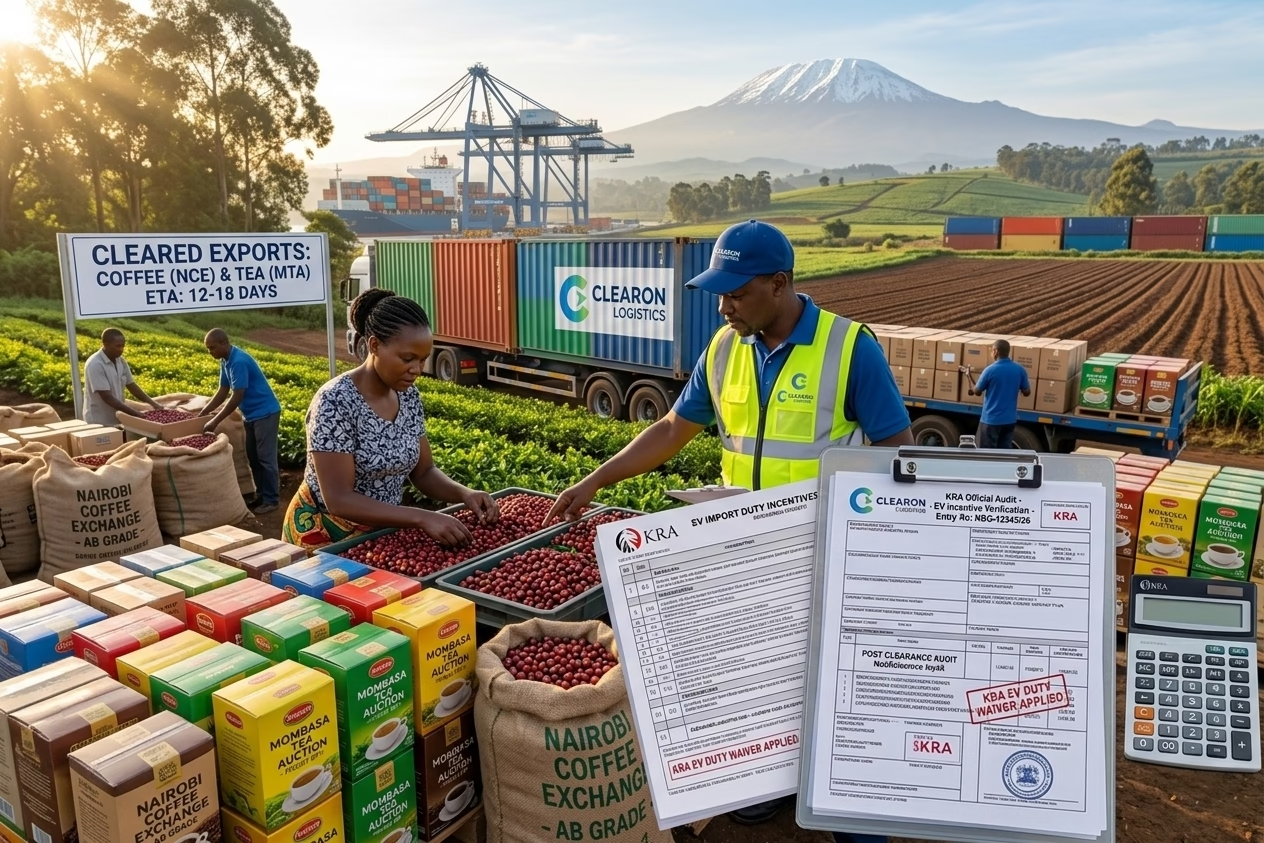
Exporting coffee and tea from Kenya taps into two of the country’s most globally recognised agricultural exports — Kenya is the world’s third-largest tea producer and the largest exporter of black tea, generating over KES 150 billion annually, while Kenyan coffee commands premium pricing that regularly outperforms commodity Arabica from larger producers like Brazil. Both sectors are also, right now, navigating genuinely significant regulatory change — a brand-new Coffee Act and a looming EU deforestation compliance deadline that’s already reshaping how exporters need to operate.
Table of Contents
The Kenya Coffee Act 2026: A New Regulatory Framework
Kenya’s coffee sector operates under a genuinely new legal framework as of 2026, replacing the previous arrangement under the Crops Act, 2013 and its associated coffee regulations. The Kenya Coffee Act 2026 introduces a three-tier licensing regime spanning the Coffee Board, county governments, and — notably — the Capital Markets Authority (CMA), which now licenses coffee exchanges and brokers under capital markets law rather than purely agricultural regulation. Key changes include 17 distinct licence categories, a significantly expanded regulatory footprint compared to the previous framework, non-transferable licences, an annual licensing cycle expiring 30 June with renewals due by 1 June, and — a genuinely positive detail for smallholders — free registration for coffee growers.
If your coffee export licensing predates this Act, it’s worth confirming your current status against the new framework rather than assuming continuity from the previous regulatory regime.
Auction vs Direct Trade for Coffee
Kenyan coffee reaches international buyers through two distinct channels:
- The Nairobi Coffee Exchange (NCE) — the traditional route, where licensed exporters bid weekly on graded coffee lots from cooperatives and estates, with licensed brokers preparing samples for buyer cupping before competitive bidding. The NCE has been under CMA oversight since a 2023 reform, improving governance, and offers genuine advantages: transparent price discovery, payment security through an established banking and warrant system, and open access for all licensed exporters and international buyers.
- Direct trade — cooperatives or estates selling directly to international roasters, bypassing the auction entirely. This channel is growing rapidly and, according to AFA data, fetched 38% more per bag than the auction average in March 2026 — a meaningful premium that’s driving increased interest in direct relationships, particularly from counties like Kirinyaga, which alone supplied 65% of Kenya’s direct export coffee volumes that same month.
Neither channel is strictly superior — the auction offers liquidity, transparency, and immediate market access, while direct trade offers materially higher pricing in exchange for the work of building and maintaining buyer relationships directly.
The EUDR Deadline Coffee Exporters Cannot Ignore
This is genuinely urgent for a huge share of Kenya’s coffee trade: the EU accounts for 55-60% of Kenya’s coffee exports, and the EU Deforestation Regulation (EUDR) makes mandatory GPS geolocation of all coffee farms a commercial non-negotiable for every Kenyan exporter selling into that market. The compliance deadlines are specific and fast-approaching: 30 December 2026 for large and medium operators, and 30 June 2027 for small and micro enterprises. Given how large a share of Kenya’s coffee trade runs through the EU, this isn’t a niche compliance detail — it’s a deadline that could functionally lock exporters out of their largest market if farm-level geolocation data isn’t in place in time.
Tea Export Runs Through a Parallel System
Tea follows a broadly similar structural pattern to coffee, but through its own dedicated institutions. Tea exporters register with the East African Tea Trade Association (EATTA) to participate in the Mombasa Tea Auction, requiring a licensed tea warehouse at the auction centre for storing lots before sale. The sector is regulated by the Tea Board of Kenya, alongside KEPHIS for phytosanitary compliance and KRA for customs and export duties — a similar multi-agency structure to coffee, just with different sector-specific institutions at the centre.
The Multi-Agency Compliance Chain
Both sectors ultimately funnel through a broadly similar compliance sequence:
- Business registration with the Business Registration Service (BRS) and a KRA PIN
- Sector-specific licensing — the Coffee Board/CMA framework for coffee, EATTA registration for tea
- VAT registration, mandatory if annual sales exceed KSh 5 million
- A Tax Compliance Certificate, renewed annually
- KEPHIS phytosanitary compliance, the same requirement covered in our broader guide to exporting fresh produce from Kenya
- Quality certification — coffee exporters commonly pursue the Diamond Mark of Quality for processed coffee specifically, requiring product testing, facility inspection, and ongoing audits
Why Direct Trade Is Growing
Beyond the pricing premium, direct trade relationships offer exporters benefits the auction system structurally can’t provide: long-term partnerships with specialty roasters, direct feedback on quality and buyer preferences, and opportunities for co-branding and storytelling that resonate with increasingly quality- and origin-conscious specialty coffee buyers. Given Kenya’s positioning as a premium origin — Kenyan AA regularly trades well above commodity Arabica from larger producers — the specialty and direct trade channel is where much of the sector’s growth momentum currently sits, even as the auction remains the primary volume channel for the broader market.
Navigating New Rules in a High-Value Export Category
Between the Coffee Act 2026’s expanded licensing framework and the EUDR’s fast-approaching geolocation deadline, coffee and tea exporters face a genuinely more complex compliance environment than even a couple of years ago — but the underlying market opportunity, particularly for direct trade and specialty positioning, remains genuinely strong.
At Clearon Logistics, we help coffee and tea exporters coordinate the logistics side of getting product to Mombasa Port and beyond, working alongside your Coffee Board, EATTA, and KEPHIS compliance to make sure shipping timelines and documentation match what your buyers and destination market regulators actually require.
Exporting coffee or tea from Kenya and need to confirm your current licensing and EUDR readiness? Talk to Clearon Logistics to coordinate your export logistics.
Frequently Asked Questions
Do I need a new licence under the Kenya Coffee Act 2026 if I was already licensed under the old framework? Given the Act replaces the previous Crops Act framework with a new three-tier licensing regime and 17 distinct licence categories, it’s worth confirming your current licensing status directly with the Coffee Board rather than assuming automatic continuity.
When do I need EUDR-compliant farm geolocation data for coffee exports to the EU? 30 December 2026 for large and medium operators, and 30 June 2027 for small and micro enterprises — given the EU represents 55-60% of Kenya’s coffee exports, this deadline affects the large majority of the sector.
Is direct trade always more profitable than selling through the Nairobi Coffee Exchange? Direct trade fetched roughly 38% more per bag than the auction average in a recent measured period, but it also requires building and maintaining buyer relationships directly, unlike the auction’s more immediate, transparent market access.
Does tea export follow the same licensing process as coffee? No — tea runs through its own parallel system, registering with EATTA for the Mombasa Tea Auction rather than the Nairobi Coffee Exchange, though both sectors share similar underlying requirements around KEPHIS compliance, KRA registration, and quality certification.
Further Reading
- Agriculture and Food Authority (AFA) — Coffee Directorate (external, dofollow)
- East African Tea Trade Association (EATTA) (external, dofollow)
- Related on our blog: Exporting Fresh Produce from Kenya: 4 Requirements for 2026
- Related on our blog: KEBS Marks Explained: 4 Certifications Importers Must Understand
- Our service: International Freight (Air & Sea)


Leave a Reply