
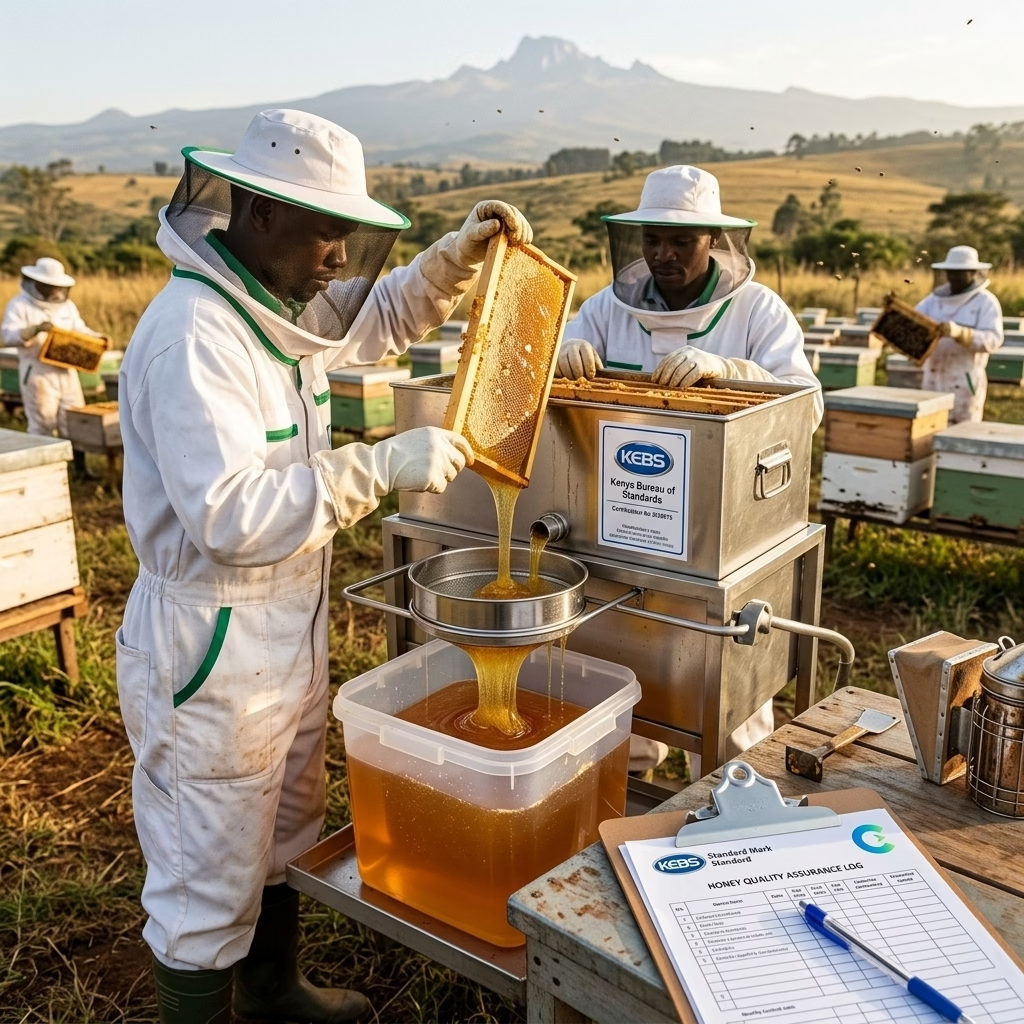
Exporting honey from Kenya is a genuine, EU-approved market opportunity that the country has, by its own production data, barely tapped — the percentage of Kenyan honey production that gets exported has never exceeded 1% in over a decade of recorded data. For a country with genuinely premium, diverse honey varieties spanning Mount Kenya’s highlands to the dry rangelands of Baringo and West Pokot, that gap between potential and actual export volume says less about market access and more about the compliance and quality infrastructure still being built out.
Table of Contents
Kenya Is Already EU-Licensed — The Gap Is Elsewhere
This is worth establishing clearly upfront: Kenya is already licensed to export honey to the European Union — one of the most demanding honey markets globally in terms of quality and authenticity standards. The constraint on export growth isn’t primarily market access approval; it’s production volume, processing consistency, and compliance infrastructure at the individual exporter and cooperative level. Given how many of Kenya’s beekeepers operate as dispersed smallholders across arid and semi-arid landscapes, building the consistent, traceable, certified supply chain that export markets expect remains a genuine, practical challenge distinct from the underlying market access question.
The Certification Chain You Actually Need
Exporting honey from Kenya runs through a defined sequence of registrations and certifications:
- A KRA export licence, the baseline requirement for any commercial export activity
- KEPHIS phytosanitary certification, confirming the honey is free from pests, diseases, and harmful substances — the same underlying plant health verification framework that applies more broadly to Kenyan agricultural exports
- KEBS certification, confirming the honey meets national quality standards, including the Standardization Mark (S-Mark) for domestic sale and the Diamond Mark specifically referenced for export-grade product, following the same KEBS marks hierarchy covered elsewhere on our blog
- A food handler certificate for every employee handling honey, issued by county public health officials
- A single business permit from the county government for your honey processing facility
- A Certificate of Analysis from an accredited laboratory, covering the specific quality parameters detailed below
What the Certificate of Analysis Actually Tests
This is where honey export genuinely differs from many other agricultural categories — a laboratory certificate of analysis specifically checks:
- Moisture content, which needs to stay below roughly 20% to confirm honey has reached proper ripeness and won’t ferment
- HMF (hydroxymethylfurfural) level, an indicator of honey freshness and improper heating during processing
- Diastase activity, an enzyme marker confirming the honey hasn’t been overheated or adulterated
- Antibiotic residues and pesticide contamination, given that bees forage across potentially treated agricultural land
Some destination markets require additional laboratory tests beyond this baseline, depending on their own specific food safety standards — worth confirming with your specific target market before finalising your testing protocol.
The Labelling Gap That’s Already Documented
A recent academic survey of honey products sold in Kenya found genuine, documented compliance gaps: flavoured honey products consistently omitted the required “flavoured honey” designation on their labels, contravening Kenya’s specific flavoured honey standard (KS EAS 1147:2024), and some honey samples sold even in supermarket settings lacked the KEBS standardization mark entirely. Perhaps most relevant for export specifically: only 40% of imported honey brands in the same survey had declared their botanical origin and processing method — a labelling standard genuinely worth exceeding, not just meeting, if you’re building an export reputation on quality and traceability.
Why Authenticity Is the Real Market Access Barrier
For honey specifically, adulteration concerns — honey diluted or mixed with cheaper syrups — represent the single biggest risk to market access in higher-compliance destinations. Import detentions, shipment rejections, and buyer delisting for Kenya-origin honey have all been linked to authenticity and residue non-compliance rather than production capacity alone. This means the single highest-value investment an aspiring Kenyan honey exporter can make isn’t necessarily increasing volume — it’s building batch-level traceability and third-party laboratory testing discipline robust enough to make authenticity claims genuinely verifiable to a skeptical, quality-conscious international buyer.
The County-Level Foundation
Given honey’s genuinely dispersed, smallholder-dominated production base, several county governments have taken an active role supporting the sector — the Baringo Honey Producers Cooperative Society is a frequently cited example of collective marketing strengthening individual beekeepers’ bargaining power and market access through bulk selling and shared processing resources. For an individual smallholder, joining or forming this kind of cooperative structure is often the practical path to meeting export-grade certification and volume requirements that would be genuinely difficult to achieve alone.
Closing the Gap Between Potential and Actual Exports
Kenya’s honey sector has real natural advantages — ecological diversity producing genuinely distinctive flavour profiles, existing EU market access, and government-level interest in supporting the sector’s growth. The path to actually capturing more of that less-than-1%-exported potential runs through consistent processing quality, rigorous laboratory testing, and labelling that exceeds rather than merely meets current standards.
At Clearon Logistics, we help honey exporters and cooperatives coordinate the logistics and export documentation side of getting certified, laboratory-tested honey to international buyers — working alongside your KEBS, KEPHIS, and county-level certification process.
Exporting honey or other bee products from Kenya? Talk to Clearon Logistics to coordinate your export logistics and documentation.
Frequently Asked Questions
Is Kenya currently allowed to export honey to the European Union? Yes — Kenya is already licensed for EU honey exports; the primary constraint on export growth is production consistency and certification infrastructure rather than market access approval itself.
What does a honey Certificate of Analysis actually check? Moisture content, HMF level, diastase activity, and screening for antibiotic and pesticide residues — parameters that together confirm honey ripeness, freshness, and safety for export markets.
Why is honey adulteration such a significant export risk? Authenticity concerns — honey diluted with cheaper syrups — are the leading cause of import detentions, shipment rejections, and buyer delisting in higher-compliance destination markets, making it the primary market access risk beyond production volume itself.
Do small-scale beekeepers need to export individually, or can they combine efforts? Cooperative structures, like the Baringo Honey Producers Cooperative Society, allow individual smallholders to achieve the volume, processing consistency, and certification standards needed for export collectively, which is often more practical than pursuing export certification alone.
Further Reading
- Kenya Bureau of Standards (KEBS) (external, dofollow)
- Kenya Plant Health Inspectorate Service (KEPHIS) (external, dofollow)
- Related on our blog: Exporting Fresh Produce from Kenya: 4 Requirements for 2026
- Related on our blog: KEBS Marks Explained: 4 Certifications Importers Must Understand
- Our service: International Freight (Air & Sea)







Leave a Reply