
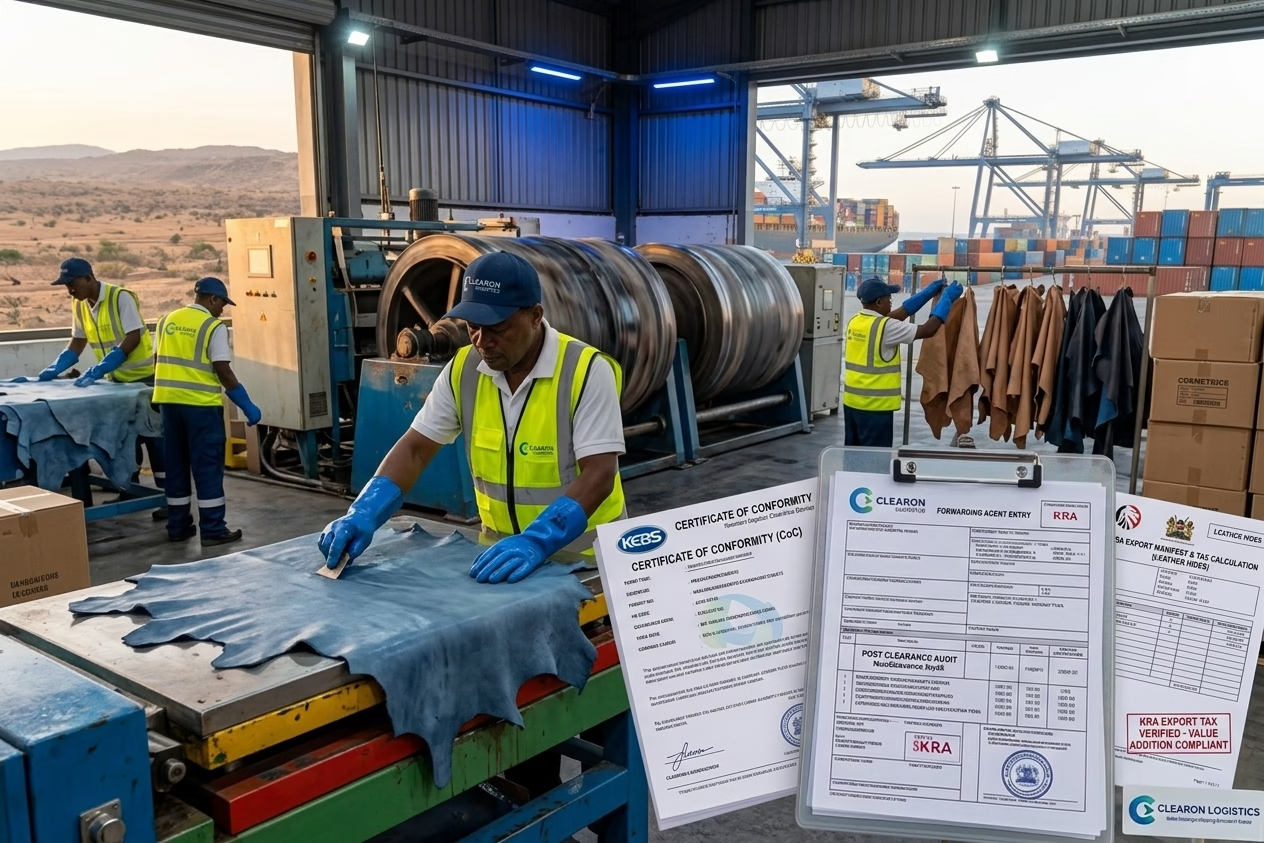
Exporting leather from Kenya means navigating one of the country’s longest-running trade policy experiments — a punitive 80% export tax on raw hides and skins, introduced specifically to force value addition into a domestic tanning industry that’s still, more than a decade later, operating well below its potential. A study published just weeks ago found that despite this tax, around 90% of Kenya’s leather exports still leave the country as raw hides, skins, or semi-processed leather — a genuinely striking outcome for anyone assuming a steep tax alone reliably reshapes an export industry’s structure.
Table of Contents
The 80% Tax: What It Was Meant to Achieve
In 2012, the Kenyan government doubled the export tax on raw hides and skins from 40% to 80% of Free On Board (FOB) value, a deliberate policy intervention aimed at making it economically painful to export leather in its rawest form, and correspondingly attractive to process it domestically first. The Kenya Leather Development Council (KLDC) has consistently defended the tax as a tool to make the sector genuinely competitive through commercialisation of higher-quality, value-added products rather than commodity raw material exports that fail to command premium global pricing.
The Fees That Actually Apply
For anyone exporting hides, skins, or leather from Kenya, the specific charges depend heavily on how much processing has already happened to the product:
- Raw hides and skins — KRA levies the full 80% export tax on FOB value, alongside a 2% Veterinary Services Development Fund (VSDF) levy from the Department of Veterinary Services
- Semi-processed leather — a reduced VSDF levy of 1%, with KRA charging no export tax at all — a deliberate incentive structure rewarding even partial value addition
- More fully processed leather — VSDF levy drops further to 0.5%, still with no KRA export tax
- Finished leather products — no levies from either KRA or the Department of Veterinary Services
This tiered structure is the clearest evidence of the policy’s actual design intent: not simply taxing leather exports generally, but specifically punishing raw, unprocessed exports while removing cost barriers entirely as processing value increases.
Why the Policy Hasn’t Fully Worked
Despite this deliberately steep tax gradient, a Kenya Institute for Public Policy Research and Analysis (KIPPRA) study — published in the last few weeks — found that roughly 90% of Kenya’s leather exports still leave the country as raw hides, skins, and semi-processed leather, despite over a decade of the value-addition tax policy being in place. Industry stakeholders have pointed to structural issues beyond the tax itself: Kenya’s existing tanneries have historically operated at well below capacity, several are foreign-owned in ways that don’t necessarily translate into expanded local processing investment, and the underlying resource base — Kenya’s cattle, goat, sheep, and camel population — represents a genuinely enormous potential raw material supply that domestic processing infrastructure simply hasn’t scaled to absorb.
The Smuggling Problem This Created
An unintended consequence of the steep tax has been significant smuggling of raw hides and skins out of Kenya, reportedly to markets like China, costing East African Community governments an estimated $30 million annually in lost tax revenue according to the Tanners Association of Kenya. This illustrates a genuine policy tension: a tax steep enough to meaningfully discourage raw exports can also create strong incentive to evade it entirely through informal or illegal channels, undermining both the revenue the tax was meant to generate and the value-addition goal it was designed to achieve.
What Value-Added Leather Export Actually Looks Like
For exporters genuinely pursuing the value-addition path the policy incentivises, the economics improve considerably at each processing stage — moving from raw hides through semi-processed (“wet blue”) leather to fully finished leather products progressively removes both KRA export tax and VSDF levy burden entirely. This mirrors the broader push, reflected in Kenya’s Budget Policy Statement priorities, toward growing manufacturing’s contribution to GDP through subsectors including leather, alongside government investment in dedicated leather industry park infrastructure specifically intended to give the tanning and finishing side of the industry room to scale.
What This Means for Exporters Right Now
- If you’re exporting raw hides and skins, budget for the full 80% FOB tax plus VSDF levy — and understand this pricing structure isn’t likely to change given how consistently the government has defended its rationale over more than a decade, despite ongoing industry pushback calling for a reduced rate
- If you’re positioned to process even partially, the tax savings from moving to semi-processed leather are substantial enough to be a genuine strategic consideration, not just a marginal improvement
- If you’re building finished leather product capacity, you’re operating in the segment the government’s entire policy framework is designed to reward, with no export tax burden at all standing in the way
Navigating a Policy That’s Still Contested
More than a decade after its introduction, Kenya’s hides and skins export tax remains a genuinely live policy debate — industry associations continuing to call for a downward revision, government bodies continuing to defend the current structure, and a recent study confirming the underlying value-addition goal remains largely unmet in practice. For exporters, understanding exactly where your product sits on this processing spectrum, and what tax treatment applies at each stage, is essential before committing to an export strategy in this sector.
At Clearon Logistics, we help leather sector exporters confirm the applicable tax and levy treatment for their specific product’s processing stage, and coordinate the logistics side of getting hides, skins, or finished leather products to international buyers compliantly.
Exporting hides, skins, or leather products from Kenya? Talk to Clearon Logistics to confirm the current tax treatment for your specific product stage.
Frequently Asked Questions
Why is there an 80% export tax specifically on raw hides and skins? The Kenyan government introduced it in 2012, doubling the previous 40% rate, specifically to discourage raw material exports and encourage domestic value addition through tanning and leather processing.
Has the 80% tax actually achieved its value-addition goal? A recent KIPPRA study found roughly 90% of Kenya’s leather exports still leave as raw hides, skins, or semi-processed leather despite the tax having been in place for over a decade — suggesting the policy hasn’t fully achieved its intended structural shift.
Do I pay the same tax rate regardless of how processed my leather export is? No — the tax structure is tiered, with the full 80% tax and higher VSDF levy applying to raw hides and skins, dropping progressively as processing increases, and no export tax at all on finished leather products.
Has the export tax created any unintended problems? Yes — it’s been linked to significant smuggling of raw hides and skins to markets like China, reportedly costing East African Community governments an estimated $30 million annually in lost tax revenue.
Further Reading
- Kenya Leather Development Council (KLDC) (external, dofollow)
- Kenya Institute for Public Policy Research and Analysis (KIPPRA) (external, dofollow)
- Related on our blog: Exporting from Kenya: The Documents You Need Before Your Cargo Leaves
- Related on our blog: AGOA and Kenya’s Textile Exports: What the 2028 Extension Actually Means
- Our service: International Freight (Air & Sea)





Leave a Reply