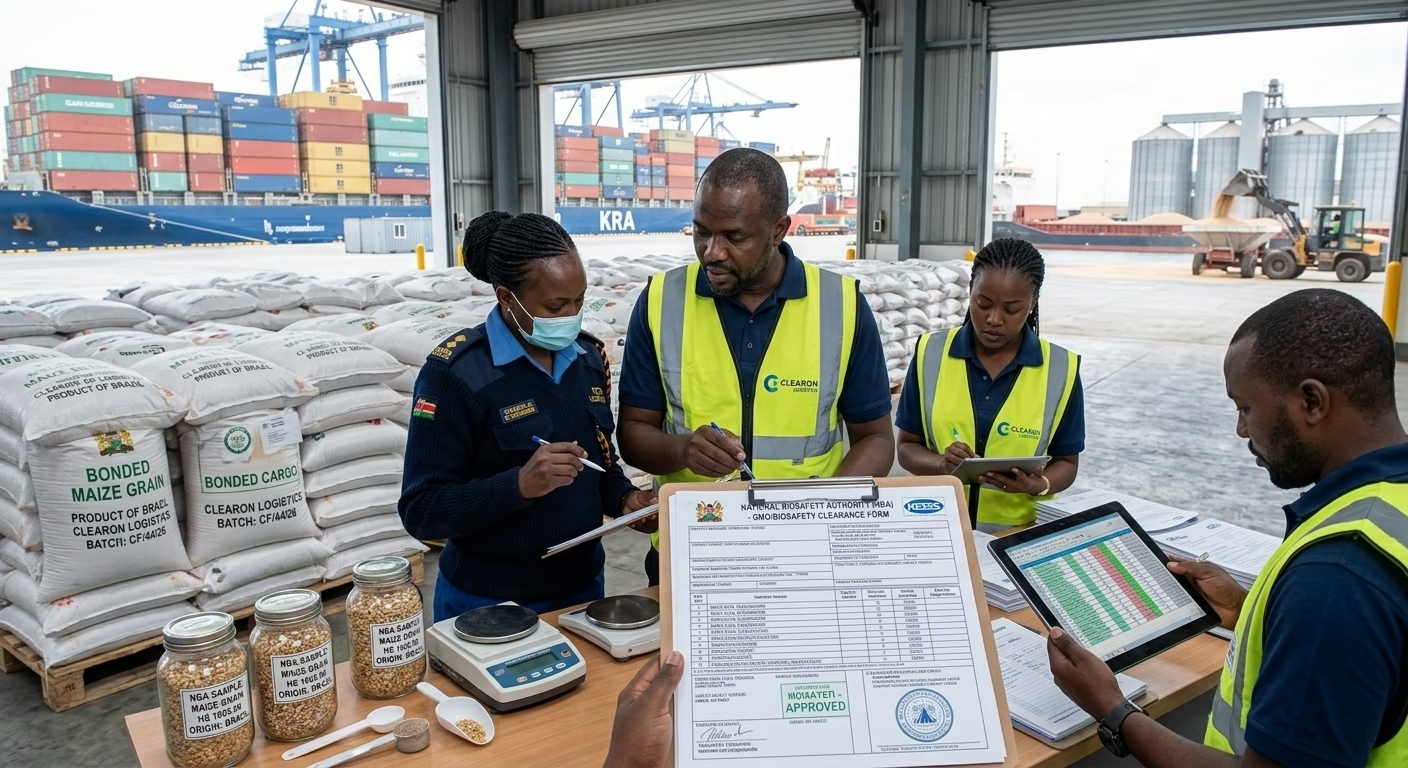
GMO imports into Kenya operate under a framework that’s changed significantly in recent years, and tightened considerably again just weeks ago. Kenya lifted its decade-long ban on genetically modified crops in October 2022 — but “lifted the ban” doesn’t mean “no longer regulated.” As of a directive issued in late June 2026, the National Biosafety Authority has instructed every agency stationed at Kenya’s ports of entry to enforce mandatory biosafety clearance on all approved GMO products, with specialist officers now deployed directly at major air and sea ports.
Table of Contents
The Ban Was Lifted — Regulation Wasn’t
Kenya’s genetically modified organism policy went through a genuine reversal in October 2022, when the government lifted a ban on cultivating and importing GM crops that had been in place for roughly a decade. Since then, Kenya has approved 58 GMO-related projects — 40 for contained laboratory or greenhouse use, 15 for confined field trials, and three approved for full environmental release or commercial cultivation, including Bt cotton (commercialised January 2020, ahead of the broader policy shift) and Bt corn. This is a meaningfully different regulatory reality than a blanket prohibition — GMOs are now a regulated, approvable category in Kenya, not a category importers can assume is entirely off-limits.
The June 2026 Directive
This is much recent: in a letter dated 29 June 2026, the NBA’s Acting CEO directed government agencies at every port of entry and exit — including KPA, KRA, KEPHIS, NEMA, KEBS, the Pest Control Products Board, the Directorate of Veterinary Services, and the Kenya Industrial Property Institute — to ensure all commercially approved GMO products receive mandatory biosafety clearance before entering or leaving Kenya. The Authority has gone further than a paper directive: it has forward-deployed specialised biosafety officers to major air and sea ports specifically to guide importers and immediately adjudicate non-compliance cases on the spot, and has pre-profiled the relevant HS codes for approved GMO product categories so port officials can identify affected shipments efficiently.
What’s Actually Approved
The NBA has published a specific list of approved genetically modified plants, animals, microorganisms, veterinary vaccines, and their derived products — importation of anything falling within these approved categories now requires NBA clearance as a condition of entry, in line with the Biosafety Act. Approved categories referenced by the NBA include products like Bt cotton, which the Authority notes is separately approved for food, feed, processing, and other uses across dozens of countries including EU member states, Japan, South Korea, and the UK — underscoring that Kenya’s approach now aligns with, rather than isolates itself from, how many major trading partners handle these same products.
Import vs Market Placement: Two Separate Approvals
Under the Biosafety Act — specifically Sections 18, 20, and 21 — no person may import, place on the market, conduct research with, or transit a GMO without the Authority’s written approval, and critically, import and market placement require separate approvals, not one clearance covering both. Applications for importing GM products already approved in other countries, falling under Section 28 of the Act, are processed within 30 days. For market placement specifically, applicants submit a separate online application, a materially more involved and costly process than import clearance alone.
What GMO Animal Feed Importers Specifically Pay
For one of the more common GMO import categories, animal feed, the NBA has published specific fees: an annual registration fee of KSh 30,000, an additional KSh 25,000 for the importation permit, and a further KSh 10,000-30,000 annually for GMO labelling, scaled to business turnover. This layered fee structure means GMO animal feed importers should budget for registration, per-transaction import permitting, and ongoing labelling compliance as three distinct, recurring costs — not a single upfront charge.
The Multi-Agency Enforcement Net
What makes the June 2026 directive particularly significant is its breadth — rather than NBA acting alone, it has explicitly brought in the full range of agencies already stationed at Kenyan ports, from customs (KRA) to plant health (KEPHIS) to standards (KEBS) to industrial property (KIPI). This mirrors the same pattern of converging, multi-agency verification covered in our piece on Kenya’s 2026 compliance overhaul — a general trend toward tighter, earlier, cross-agency verification rather than relying on any single regulator to catch non-compliance alone.
Getting GMO Imports Right in a Tightening Environment
Given how recently and specifically enforcement has intensified — a June 2026 directive, on-site officers, and pre-profiled HS codes specifically to catch non-compliant GMO shipments — this is not a category where an importer can reasonably assume older, looser practices still apply. If your product falls anywhere near the approved GMO categories, confirming NBA clearance status before shipping is now considerably more consequential than it may have been even a year ago.
At Clearon Logistics, we help importers of agricultural and food products confirm whether their goods fall under NBA’s GMO clearance requirements, and coordinate this alongside the broader food import compliance framework covered elsewhere on our blog — since GMO status is now an active, actively enforced checkpoint, not a background consideration.
Importing agricultural products, animal feed, or food items that might involve GMO content? Talk to Clearon Logistics to confirm your NBA clearance status before you ship.
Frequently Asked Questions
Is it currently legal to import GMO products into Kenya? Yes, for approved categories — Kenya lifted its GMO import and cultivation ban in October 2022, and approved products (like Bt cotton and Bt corn) can be imported with proper National Biosafety Authority clearance.
What changed in June 2026 regarding GMO imports? The NBA directed every agency at Kenya’s ports of entry to enforce mandatory biosafety clearance on all approved GMO products and deployed specialist biosafety officers directly at major air and sea ports to catch non-compliant shipments on the spot.
Do I need separate approvals to import a GMO product and to sell it in Kenya? Yes — import and market placement require separate approvals under the Biosafety Act, not a single clearance covering both stages.
What does it cost to import GMO animal feed into Kenya? An annual registration fee of KSh 30,000, an additional KSh 25,000 for the import permit, and KSh 10,000-30,000 annually for GMO labelling depending on business turnover — three separate, recurring costs.
Further Reading
- National Biosafety Authority (NBA) Kenya (external, dofollow)
- Kenya Law — Biosafety Act, 2009 (external, dofollow)
- Related on our blog: Importing Food and Beverage Products into Kenya: 5 Rules to Know
- Related on our blog: Kenya’s 2026 Import Compliance Overhaul: Every Change in One Place
- Our service: Clearing and Forwarding Services in Kenya







Leave a Reply