
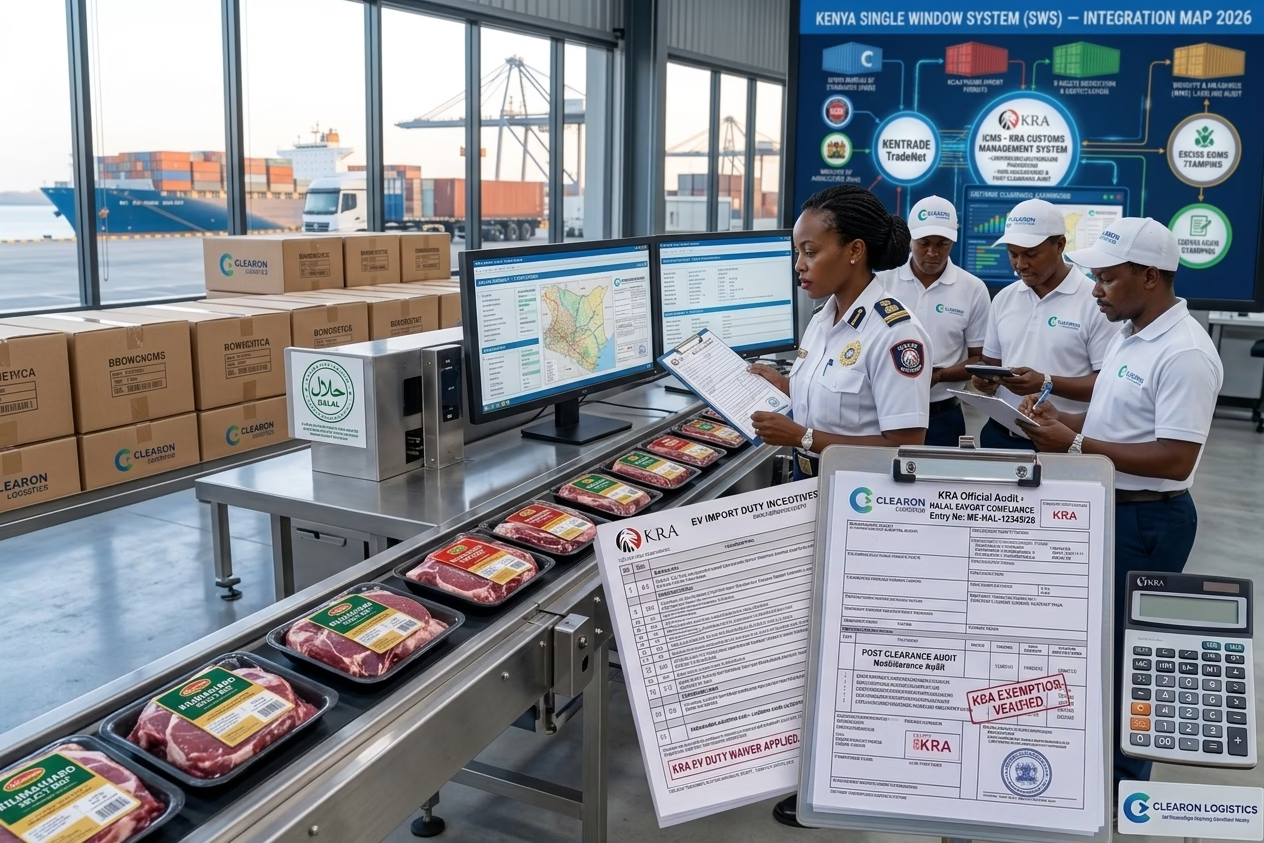
Halal certification for Kenyan exports sits at the centre of a genuine growth opportunity — the Middle East remains a major net importer of food and agricultural products, and Kenya’s geographic position gives it real advantage in supplying that demand. But there’s a structural gap worth understanding before you build an export strategy around it: Kenya currently has no single national halal authority, and the government has only just, as of a few weeks ago, begun formally discussing creating one.
Table of Contents
Why This Market Matters for Kenyan Exporters
Speaking on behalf of Kenya’s Ministry of Foreign and Diaspora Affairs, officials have specifically identified the Middle East as a major opportunity for Kenyan agricultural and livestock exporters, given the region’s status as a significant net importer of food products and Kenya’s geographical positioning. Beyond the Gulf states, the broader global halal economy is commonly valued in the trillions of dollars, spanning food, cosmetics, pharmaceuticals, and logistics — a market considerably larger than religious dietary compliance alone would suggest, since halal certification increasingly functions as a broader quality and ethical-sourcing signal that appeals well beyond Muslim consumers specifically.
The Regulatory Gap Kenya Is Still Closing
This is worth being direct about: as of the most recent public discussion on the topic, Kenya does not yet have a formal, unified national halal certification authority. A Ministry of Foreign Affairs official has publicly proposed establishing one — including a national halal authority and stronger, more formal involvement from the Kenya Bureau of Standards in overseeing halal compliance — specifically to strengthen Kenya’s credibility in international halal markets and give local consumers greater confidence in certified products. Until that framework is formalised, halal certification in Kenya currently operates through private certification bodies, whose credibility depends on international recognition by the destination market’s own import authorities, rather than a single Kenyan government standard.
For an exporter, this means the practical question isn’t “does Kenya have halal certification” — it’s “does my specific certification body’s halal certificate carry recognition with the importing authority in my target market,” since not all certifiers carry equal weight with GCC customs and import authorities.
The International Standards Buyers Actually Check
Two Gulf Standardisation Organisation standards commonly anchor halal certification credibility in Middle Eastern trade: GSO-1:2015 (Halal Food — Part 1: General Requirements) and GSO 2055-2:2021 (Halal Products — Part 2: General Requirements for Halal Certification Bodies). Kenya’s own accreditation body, the Kenya Accreditation Service (KENAS), has been actively working to build local assessor capacity against these standards, training certification bodies to meet international quality expectations — a sign that the underlying infrastructure is developing even ahead of a formal national authority being established.
How Halal Certification Interacts With Other Requirements
Halal certification doesn’t replace the standard export compliance chain — it sits alongside it. For meat exports specifically, a typical compliant operation combines:
- Halal certification from an internationally recognised body accepted by the destination market’s import authorities
- HACCP-based processing standards, which are effectively mandatory for EU and US markets and increasingly expected across serious export operations regardless of destination
- KEBS and Kenya Veterinary Authority (KVA) compliance, covering general product standards and animal health requirements
- Cold chain documentation — temperature logging throughout transport, since halal meat exports to the Gulf are typically shipped frozen with continuous temperature records included in shipment documentation
- Batch traceability, linking each consignment back to animal sourcing, halal slaughter documentation, and processing dates
What Successful Kenyan Halal Exporters Actually Do
Kenya has already built a genuine track record in halal meat exports specifically — companies shipping premium beef, goat, and lamb to the UAE, Saudi Arabia, Bahrain, Kuwait, Qatar, and Oman, working with freight forwarders experienced specifically in GCC food import requirements rather than general logistics providers. The pattern among established exporters is consistent: halal certification from a body genuinely accepted by GCC importing authorities, HACCP-aligned processing, and meticulous batch-level documentation that a buyer can request and verify for any specific shipment.
Beyond Meat: Where Else Halal Certification Applies
While meat and food products are the most visible halal export category, the certification’s relevance extends further:
- Cosmetics and personal care products, where halal certification increasingly functions as a marketable quality signal in Gulf and Southeast Asian markets, alongside the standard KEBS and PPB requirements that already apply
- Pharmaceuticals, where certain markets require halal-compliant sourcing for specific product categories
- Logistics and storage, since maintaining halal certification integrity requires segregating halal products from non-halal goods throughout storage and transport — a supply chain consideration, not just a production-line one
Building a Halal Export Strategy on Solid Ground
Given that Kenya’s formal regulatory framework for halal certification is still developing, the safest approach for an exporter right now is building relationships with certification bodies whose credentials are already, demonstrably accepted by your specific target market’s import authorities — rather than assuming any Kenyan halal certificate carries automatic recognition abroad.
At Clearon Logistics, we help exporters coordinate the logistics side of halal-certified shipments — cold chain integrity, documentation coordination alongside HACCP and KEBS requirements, and ensuring the certification your buyer expects is properly reflected in your shipping documentation.
Exporting halal-certified products from Kenya to the Middle East or beyond? Talk to Clearon Logistics to coordinate your logistics around your specific certification and market requirements.
Frequently Asked Questions
Does Kenya have a national halal certification authority? Not yet — as of the most recent public discussion, Kenya operates through private certification bodies, and a government official has only recently proposed establishing a formal national halal authority with stronger KEBS involvement.
Which halal standards do Middle Eastern buyers typically recognise? GSO-1:2015 and GSO 2055-2:2021, both Gulf Standardisation Organisation standards, commonly anchor halal certification credibility in GCC trade, though specific buyer requirements can vary by market and product.
Is halal certification only relevant for meat and food exports? No — while meat and food are the most visible categories, halal certification also applies to cosmetics, pharmaceuticals, and has supply chain implications for logistics and storage where segregation from non-halal goods matters.
Do I still need standard export certifications if my product is halal-certified? Yes — halal certification sits alongside, not instead of, standard requirements like HACCP, KEBS certification, and veterinary health certificates, all of which typically apply together for a compliant export.
Further Reading
- Kenya Accreditation Service (KENAS) (external, dofollow)
- Kenya Bureau of Standards (KEBS) (external, dofollow)
- Related on our blog: Exporting Fresh Produce from Kenya: 4 Requirements for 2026
- Related on our blog: Importing Cosmetics into Kenya: 4 Facts on KEBS vs PPB Regulation
- Our service: International Freight (Air & Sea)




Leave a Reply