
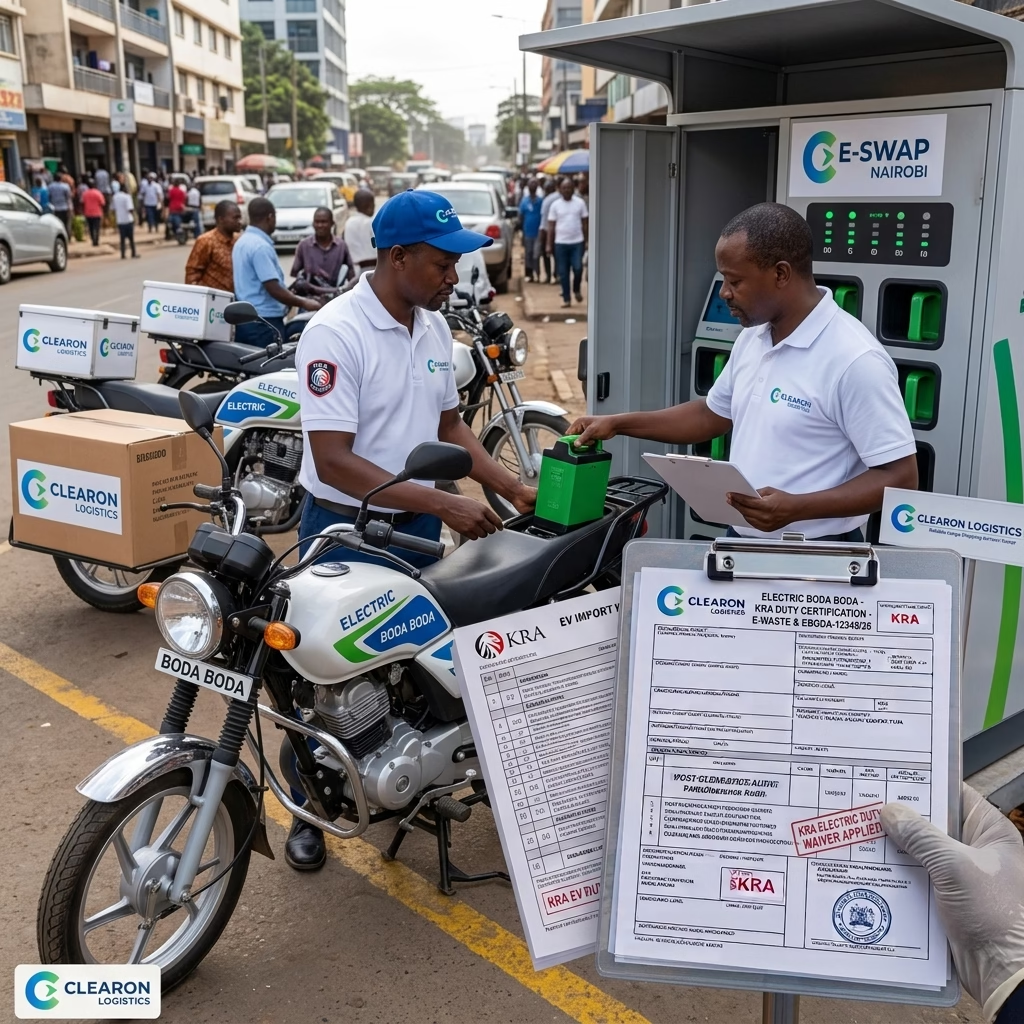
Importing motorcycles into Kenya means importing into the backbone of the country’s informal transport economy — boda bodas carry passengers, deliveries, and goods across nearly every town and city, and the sector is currently in the middle of a genuine technological shift toward electric power that’s reshaping both the import economics and the competitive landscape.
Table of Contents
Standard Petrol Motorcycle Import Basics
Petrol motorcycle imports follow Kenya’s standard vehicle import framework — duty calculated on an assessed value basis, subject to the same general customs documentation required for any commercial vehicle import, including IDF, RDL, VAT, and applicable excise duty. KRA maintains a dedicated motorcycle import duty calculator specifically because valuation and duty for this category has enough specific variables — engine capacity, age, condition — that it warrants its own dedicated tool separate from general vehicle calculations.
The Electric Motorcycle Incentive Structure
This is where the real change has happened. Under Kenya’s 2026 e-mobility policy, electric motorcycles benefit from a genuinely favourable tariff structure compared to petrol equivalents — a continuation of the broader shift already reshaping electric vehicle imports generally. Government VAT exemptions and reduced excise duties introduced in 2026 have lowered import costs for electric motorcycles by a meaningful margin, and while a fully built electric unit may still carry a higher upfront price than a comparable petrol bike, the total cost of ownership case is increasingly compelling — operating costs for electric motorcycles in Nairobi are commonly cited as running considerably lower than petrol equivalents, given how much cheaper electricity is than fuel per kilometre travelled.
CKD vs CBU: Why the Distinction Matters
For anyone importing electric motorcycles at meaningful scale, one classification distinction has outsized financial impact:
- CKD (Completely Knocked Down) kits — components imported for local assembly — currently attract 0% import duty, a significant incentive specifically designed to encourage local assembly operations and manufacturing investment in Kenya rather than importing finished units
- CBU (Completely Built Units) — fully assembled motorcycles imported ready to use — still face applicable levies, though these are generally lower than the excise duty structure applied to equivalent petrol motorcycles
This distinction is deliberately structured to favour businesses building local assembly capacity over those simply importing finished electric motorcycles for resale — worth factoring into any decision about whether to enter this market as a straightforward importer or as an assembly operation.
Why Global Manufacturers Are Racing Into This Market
Kenya’s boda boda economy has become a genuine focal point for international electric vehicle manufacturers. Chinese manufacturer YADEA, for example, debuted its KIFA electric motorcycle at Autoexpo Kenya 2026, specifically designed around the dual passenger-and-delivery use case that defines boda boda operations, featuring a 250-kilogram payload capacity and swappable lithium iron phosphate batteries offering roughly 150 kilometres of range with battery swaps completed in around 30 seconds — engineered specifically to minimise downtime for riders whose earnings depend on continuous operation. Africa’s electric motorcycle and three-wheeler imports from China rose nearly 60% in the first half of 2026 alone, reflecting how quickly manufacturers and investors are moving to capture this shift.
The economic stakes extend well beyond individual rider earnings — industry estimates suggest widespread motorcycle electrification could eventually displace hundreds of millions of dollars in annual fuel imports for Kenya, a genuine macroeconomic consideration behind the government’s incentive structure, not just a environmental talking point.
Importing Motorcycle Spare Parts Separately
Beyond complete motorcycles, Kenya’s boda boda sector runs on a constant restocking cycle of spare parts — brake pads, chains and sprockets, spark plugs, clutch plates, piston kits, and electrical components like CDI units. Importing these directly from manufacturers rather than buying through a domestic wholesaler can meaningfully reduce cost for businesses with sufficient order volume to absorb freight and clearance costs — though this generally only makes commercial sense once restocking volume is high enough to be a regular, ongoing import relationship rather than a one-off order, given the fixed costs involved in clearance regardless of shipment size.
The Bigger Economic Picture
Whether you’re importing complete motorcycles or spare parts, this category sits at an interesting intersection of Kenya’s transport economy, informal-sector livelihoods, and an active government push toward electrification. The incentive structure — CKD favoured over CBU, electric favoured over petrol — reflects deliberate policy choices, not just standard tariff bands, which means understanding the current incentive landscape genuinely changes the economics of how you might choose to enter this market.
At Clearon Logistics, we help motorcycle and motorcycle parts importers navigate the current duty structure — including the CKD/CBU distinction and electric incentive framework — so your import strategy reflects the most favourable current treatment for your specific business model, whether that’s assembly, complete unit import, or parts distribution.
Importing motorcycles or motorcycle parts into Kenya? Talk to Clearon Logistics to confirm the most current duty treatment for your specific import model.
Frequently Asked Questions
Is it cheaper to import electric motorcycle components (CKD) or complete units (CBU)? Generally CKD kits, which currently attract 0% import duty specifically to encourage local assembly, while complete built units still face applicable levies, albeit lower than equivalent petrol motorcycles.
Are electric motorcycles actually cheaper to operate than petrol ones in Kenya? Commonly cited estimates suggest electric motorcycle operating costs in Nairobi run considerably lower than petrol equivalents, given the cost difference between electricity and fuel per kilometre, though upfront purchase price can be higher.
Does importing motorcycle spare parts directly from manufacturers make sense for any importer? It generally only makes financial sense once order volume is large enough to absorb freight and clearance costs as a regular, ongoing restocking relationship rather than occasional small orders.
Why is Kenya’s boda boda sector attracting international EV manufacturer investment? The scale of the market, combined with favourable government incentives and the sector’s dependence on continuous vehicle operation, has made Kenya a focal point for global electric motorcycle manufacturers expanding into East Africa.
Further Reading
- Kenya Revenue Authority — Motorcycle Import Duty Calculator (external, dofollow)
- Ministry of Roads and Transport — National e-Mobility Policy (external, dofollow)
- Related on our blog: Importing Electric Vehicles into Kenya: 5 Incentives to Verify Now
- Related on our blog: Sourcing from China: 6 Essential Tips for Kenyan Importers
- Our service: Clearing and Forwarding Services in Kenya
Leave a Reply