
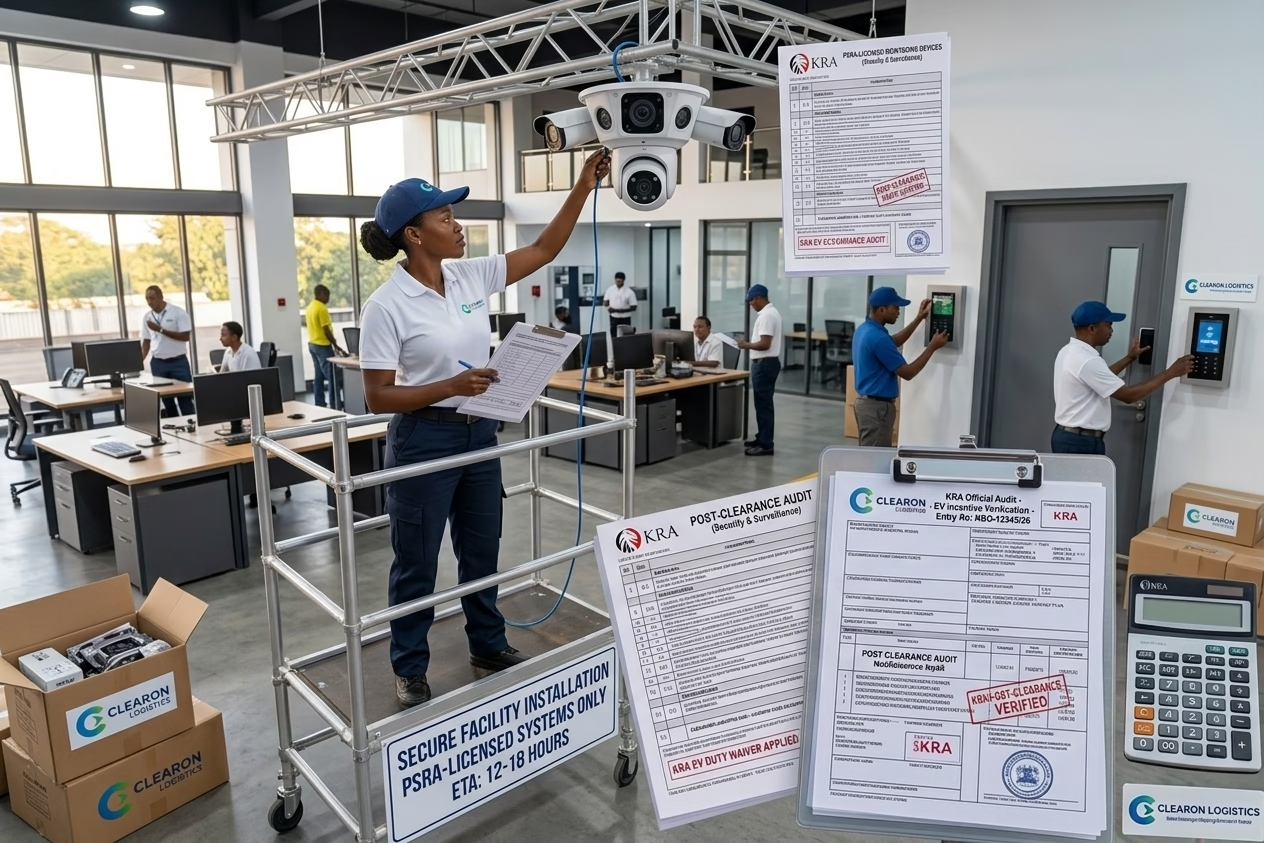
Importing security and surveillance equipment into Kenya — CCTV cameras, burglar alarms, access control systems, car tracking devices — falls under a regulator most importers wouldn’t immediately think to check: the Private Security Regulatory Authority. This isn’t a niche technicality. PSRA’s own governing law explicitly names manufacturing, importing, distributing, and advertising of monitoring devices as a regulated private security activity, meaning a straightforward commercial import of CCTV equipment carries a licensing requirement most electronics importers never encounter.
Table of Contents
Why Security Equipment Falls Under PSRA at All
The Private Security Regulatory Authority, established under the Private Security Regulation Act No. 13 of 2016, exists to regulate, administer, supervise, and control Kenya’s entire private security industry — a mandate that extends well beyond security guards and patrol services. The Act explicitly lists manufacturing, importing, distributing, and/or advertising of monitoring devices among the specific activities requiring regulation, alongside more obvious categories like guarding services, cash-in-transit security, and burglar alarm installation. This reflects a genuine security policy concern: monitoring and surveillance equipment has real implications for privacy, security, and potential misuse, similar in spirit to why drones fall under aviation-level scrutiny rather than being treated as ordinary consumer electronics.
What Counts as Regulated Equipment
Based on PSRA’s own listed scope of regulated activities, this covers:
- Closed-circuit television (CCTV) systems
- Burglar alarms and other protective equipment
- Access control installation systems
- Car tracking and surveillance devices
- General monitoring devices, a broad category capturing surveillance and monitoring technology more generally
If your import falls into any of these categories — whether you’re a security company bringing in equipment for installation projects, or a distributor importing stock for resale — PSRA licensing applies, separate entirely from any standard KEBS or type approval requirements the equipment might also need.
The Licensing Process
Getting licensed involves several stages, more thorough than a typical import registration:
- Application submission to PSRA, either physically or online, including company registration documents and required supporting materials
- Inspection of premises — PSRA physically verifies your business location meets required standards, including adequate space for operations and secure storage
- Assessment of personnel — for security service providers specifically, staff training credentials and background checks are reviewed
- Demonstration of financial capacity — proof of financial stability sufficient to sustain operations
- Payment of licensing fees, which vary depending on the specific type of security service or activity
For companies specifically involved in importing, manufacturing, or distributing monitoring devices — as opposed to providing on-the-ground guarding or installation services — the process focuses more heavily on the business and equipment side, though the overall PSRA vetting approach applies broadly across all regulated activities.
New Regulations From November 2025
PSRA’s regulatory framework was updated with new General Regulations gazetted in November 2025, introducing more detailed and formalised procedures, including specific application forms (such as Form PSR 8 for registration and renewal of specific roles including security equipment installers, operators, and servicemen). Renewal applications now need to be submitted at least 30 days before expiry of the existing registration or licence. If your business has operated under older PSRA procedures, it’s worth confirming your current compliance status reflects these more recently formalised requirements rather than assuming the older process still applies unchanged.
Foreign Companies Face an Extra Step
PSRA’s own guidance specifically addresses a common question: companies already licensed as private security providers in another country cannot rely on that foreign licence to operate in Kenya. A separate Kenyan PSRA licence is required regardless of existing international credentials or licensing elsewhere — meaning an established international security equipment brand entering the Kenyan market still needs to go through Kenya’s own licensing process from the start, not simply register an existing foreign licence.
How This Sits Alongside Standard Import Requirements
PSRA licensing doesn’t replace standard customs and product compliance requirements — it sits alongside them. A fully compliant security equipment import generally still needs:
- Standard customs documentation — IDF, Certificate of Origin, commercial invoice
- Any applicable KEBS or Communications Authority type approval requirements, particularly for equipment with wireless or networked communication capability
- Correct HS code classification for accurate duty assessment
Missing the PSRA licensing layer while having otherwise perfect customs documentation still leaves you non-compliant — this is an additional requirement, not an alternative to standard import compliance.
Getting Security Equipment Imports Right From the Start
Because PSRA licensing involves premises inspection, personnel assessment, and financial capacity verification — a more involved process than most standard import registrations — this is a category where the compliance timeline needs to be planned well ahead of your first shipment, not addressed reactively once equipment has already arrived.
At Clearon Logistics, we help security equipment importers and distributors understand how PSRA licensing interacts with standard customs and product compliance requirements, so your import strategy accounts for the full regulatory picture from the start, not just the customs side alone.
Importing CCTV, alarms, or other security and surveillance equipment into Kenya? Talk to Clearon Logistics to confirm your PSRA licensing status alongside your customs documentation.
Frequently Asked Questions
Do I need a PSRA licence just to import CCTV cameras for resale, or only for installation services? PSRA’s governing law explicitly lists manufacturing, importing, distributing, and advertising of monitoring devices as a regulated activity — meaning importing for resale falls within scope, not just on-the-ground installation or guarding services.
Can I use my company’s existing security licence from another country to operate in Kenya? No — PSRA explicitly requires a separate Kenyan licence regardless of existing licensing or accreditation held in another country.
How far in advance should I renew my PSRA licence or registration? At least 30 days before expiry, under PSRA’s updated General Regulations gazetted in November 2025.
Does PSRA licensing replace the need for standard customs documentation on security equipment imports? No — it’s an additional requirement alongside standard customs documentation, KEBS certification, and any applicable type approval requirements, not a substitute for them.
Further Reading
- Private Security Regulatory Authority (PSRA) (external, dofollow)
- Private Security Regulation Act No. 13 of 2016 (external, dofollow)
- Related on our blog: Importing Drones into Kenya: 5 KCAA Permits You Cannot Skip
- Related on our blog: Importing Telecommunications Equipment into Kenya: 5 Urgent CED Facts
- Our service: Clearing and Forwarding Services in Kenya











Leave a Reply