
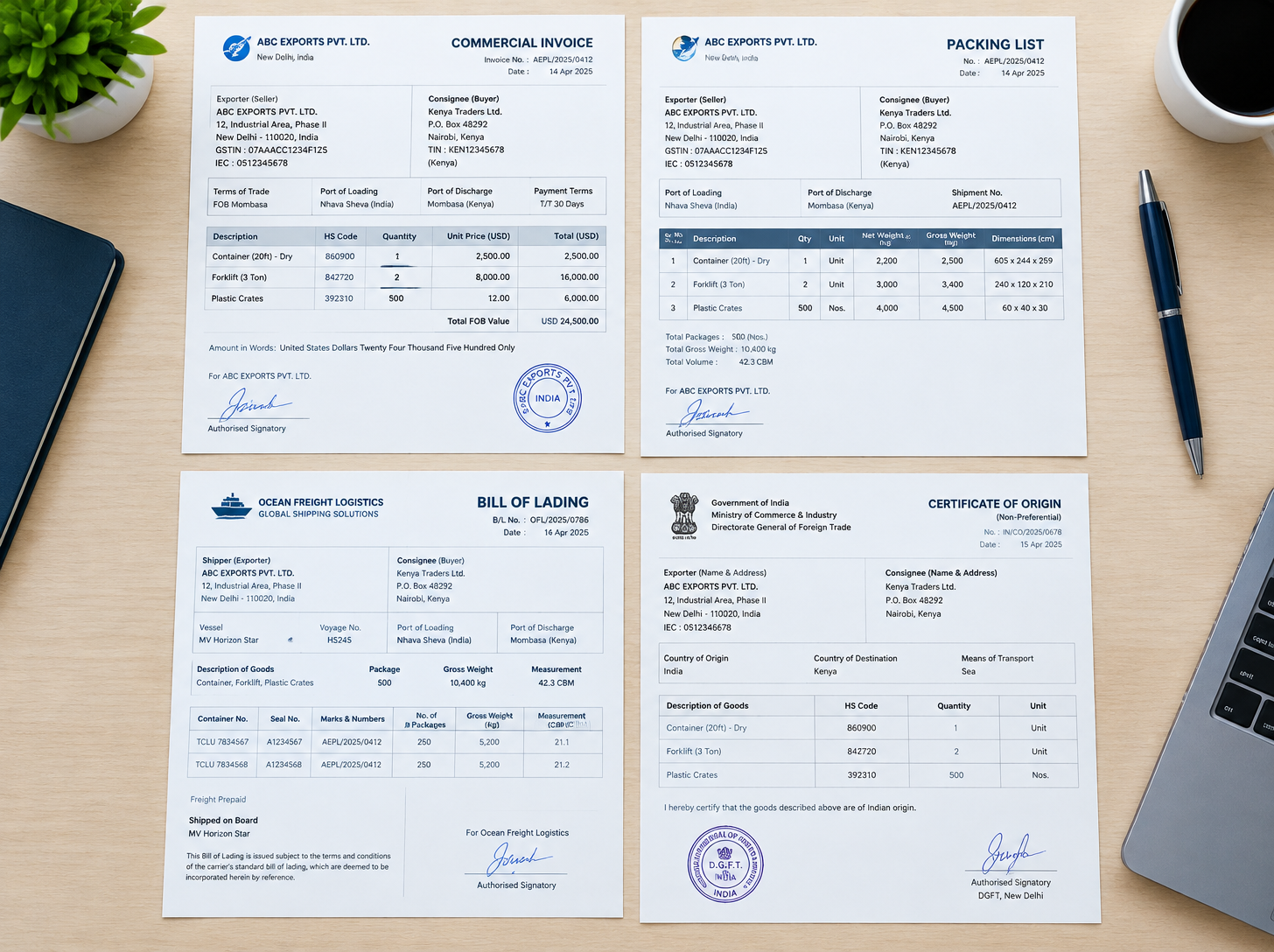
Indian export documents are the paperwork your Indian supplier must prepare before your goods can leave India. If one is missing or wrong, your cargo can sit at an Indian port, and the same errors can cause trouble on arrival in Kenya. You don’t prepare these yourself, but you do need to know what to ask for. We handle freight from India by sea and air on EXW and FOB terms, and ideally we walk clients through this before shipping.
Table of Contents
Commercial Documents
Commercial invoice. It should show the full goods description, quantity, unit price, total value, the agreed delivery term and the supplier’s IEC. Kenya Revenue Authority uses the invoice to assess duty, so the value must match what you actually paid.
Packing list. It must match the invoice, package for package. Differences between the two are a common reason for queries at clearance.
Bill of lading (sea) or air waybill (air). Issued by the carrier once the goods are loaded. Check the consignee name, goods description and port of discharge before you pay the balance to your supplier.
Indian Export Documents: The Regulatory Set
Importer-Exporter Code (IEC). A 10-digit code issued by India’s DGFT. An Indian exporter cannot file a shipping bill without one.
Shipping bill. This is the export declaration filed with Indian Customs under Section 50 of the Customs Act, 1962, drawing on the invoice, packing list, IEC, bank details and GST details. Your supplier or their customs broker normally files it. On EXW terms, agree in writing who arranges it. Our guide to EXW vs FOB from India explains why.
GST position. Indian exporters usually ship under a Letter of Undertaking (LUT), without paying IGST, or pay IGST and claim a refund. The LUT is renewed each financial year. This is your supplier’s responsibility, but a supplier who hasn’t sorted it out may delay shipment.
The Certificate of Origin
Kenya has required a Certificate of Origin for every import since 1 October 2025. On the Indian side, non-preferential certificates are issued by agencies authorised by DGFT, mainly chambers of commerce and export bodies, through an online platform, and filing has been electronic-only since 2025. The exporter applies using their IEC, invoice and packing list.
Platforms and rules change, so confirm the format Kenya expects with us before your supplier applies. Fixing a certificate after the goods have shipped is slow and sometimes impossible.
Before Loading: ACD and Certificates
For containerised sea cargo, the Advance Cargo Declaration reference must be on the Bill of Lading before loading, or the container can be refused. Kenya also requires an export declaration document, a Certificate of Conformity for regulated products and ISPM 15-compliant wood packaging. Our prohibited and restricted goods guide helps you check your product.
Common Mistakes to Avoid
- Values that differ across documents. The invoice, packing list and bill of lading should tell the same story.
- Vague goods descriptions. “Spare parts” or “machinery” invites questions. Ask for specific descriptions and HS codes.
- Consignee errors. Name, address and tax details must match your Kenyan company records.
- A late Certificate of Origin. Ask for it before shipment, not after.
- Paying in full before seeing drafts. Ask for draft copies of the invoice, packing list and bill of lading first.
What We Need to Quote Your Shipment
- What the product is, and its HS code if you know it
- Your supplier’s location in India (city and state), which decides the port or airport
- Cargo size: cartons or pallets, total cubic metres (CBM) and gross weight in kg
- The delivery term on your supplier’s quotation (EXW or FOB) and the supplier’s contact
- Your target arrival date, and any permits or certificates your product needs
- Draft invoice and packing list, if you already have them
Want us to look over your supplier’s documents before the cargo ships? Send them through and we’ll tell you what looks wrong or missing.
Frequently Asked Questions
Which Indian export documents should I see before shipment? At minimum the commercial invoice, packing list, Certificate of Origin and the draft bill of lading or air waybill. Ask for the supplier’s IEC as well.
Who files the shipping bill? The Indian exporter, usually through a customs broker. Agree this in writing, especially on EXW terms.
Does the Certificate of Origin come from the Indian government? It is issued by an agency authorised by DGFT, such as a chamber of commerce, through an online platform. Confirm the format Kenya requires with us before your supplier applies.
Are the documents the same for air freight? Air freight uses an air waybill instead of a bill of lading, but the invoice, packing list, shipping bill and Certificate of Origin are still needed.
Further Reading
- DGFT, India: Importer-Exporter Code and trade notices (external, dofollow)
- India trade portal: Certificate of Origin (external, dofollow)
- Related on our blog: Shipping from India to Kenya: FCL, LCL and Air Compared
- Related on our blog: LCL Shipping from India to Kenya
- Related on our blog: EXW vs FOB from India to Kenya
- Related on our blog: India vs China Importing to Kenya
- Our service: China to Kenya Shipping Service




Leave a Reply