
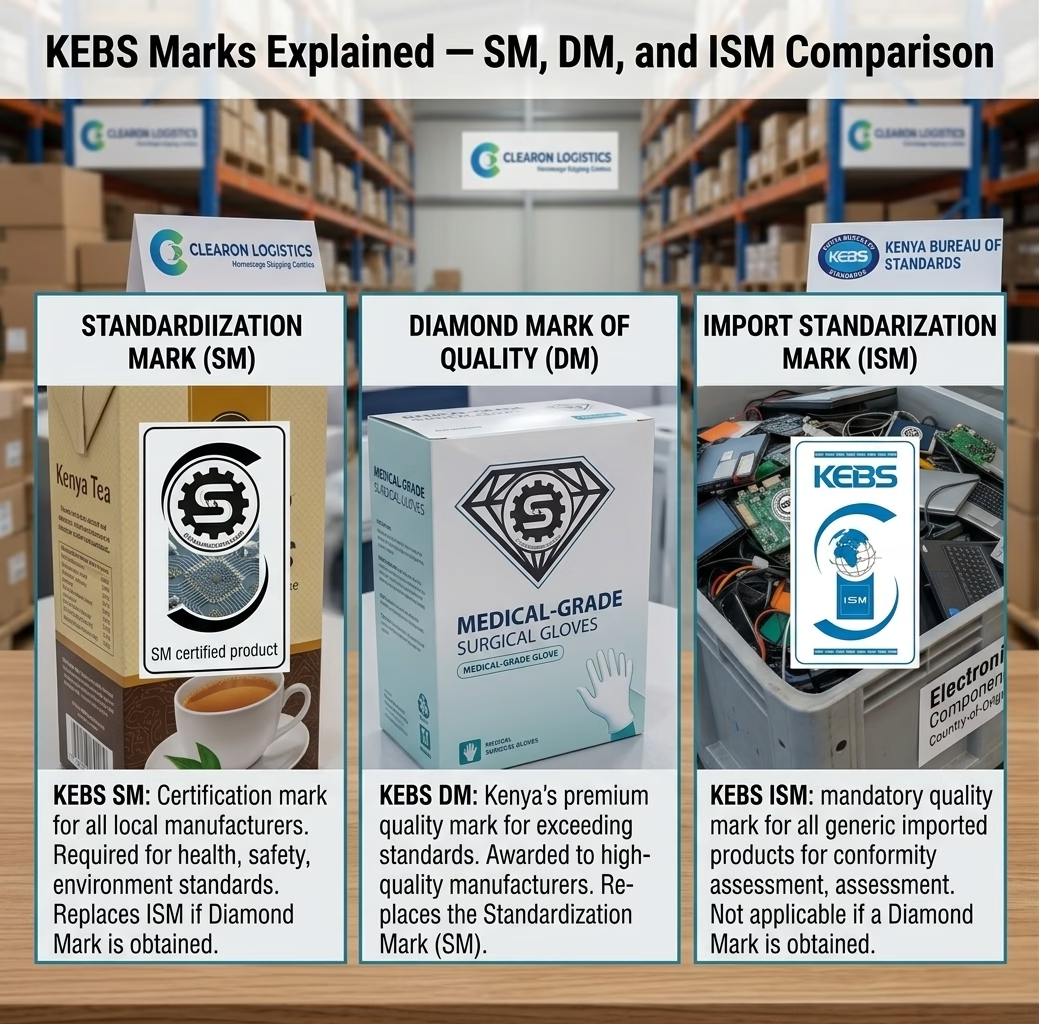
KEBS marks get referenced constantly across import compliance guidance — Standardization Mark, Diamond Mark, Import Standardization Mark, Certificate of Conformity — often without ever clearly explaining how these relate to each other. If you’ve been importing into Kenya for a while and still aren’t entirely sure which mark applies to your product, or why some products seem to need two different certifications, this is the clarification worth reading once, properly.
Table of Contents
The Standardization Mark: The Baseline for Local Products
The Standardization Mark (S-Mark) is KEBS’s mandatory certification scheme specifically for locally manufactured products — confirming a product conforms to the relevant Kenyan Standard. This is the entry-level, baseline certification for Kenyan manufacturers, covering an enormous range of goods, from tissue paper to liquid soap, and it’s what most people picture when they think of “a KEBS mark” on a product made in Kenya.
Critically for importers: the Standardization Mark is not the certification your imported goods need. It’s designed for products manufactured within Kenya, which is exactly why a separate mark exists for imports, covered further down.
The Diamond Mark: A Premium Tier, Not a Separate Requirement
The Diamond Mark (D-Mark) is a voluntary, premium certification — available to manufacturers based locally or abroad — that goes beyond baseline standard compliance to confirm a documented quality management system, consistent production discipline, and demonstrated manufacturing excellence over time. It’s valid for a longer period (commonly cited around three to four years, compared to shorter S-Mark cycles) and, notably, D-Mark permit holders automatically qualify for the Standardization Mark too, without additional payment — meaning the Diamond Mark sits above, not alongside, the Standardization Mark in the same certification hierarchy, rather than being a competing or separate scheme.
For most importers, the Diamond Mark is relevant mainly if you’re sourcing from an overseas manufacturer who holds it — it signals a genuinely high standard of quality control on the supplier’s end, even though it’s not itself the mark your specific import shipment needs for Kenyan clearance.
The Import Standardization Mark: The One That Actually Applies to You
This is the mark that matters most for anyone reading our blog as an importer. The Import Standardization Mark (ISM) was introduced specifically to address counterfeiting of KEBS marks and applies to imported products intended for sale in the Kenyan market. It comes as a sticker with track-and-trace technology, sourced directly from KEBS, and importers apply for it by submitting their Certificate of Conformity, Import Declaration Form, and Customs Entry — meaning the ISM sits at the end of a documentation chain, not as a standalone first step.
If you’ve read our posts on construction materials or general certificate of conformity requirements, this is the mark those pieces have been referring to — the ISM is the practical, physical confirmation that a specific imported consignment has been verified against the relevant Kenyan Standard.
How ISM Connects to PVoC and the Certificate of Conformity
The ISM doesn’t exist in isolation — it’s the final step in a sequence:
- Pre-Export Verification of Conformity (PVoC) inspection happens in the country of export, before shipment, through a KEBS-appointed inspection agent
- A Certificate of Conformity (CoC) is issued following successful PVoC inspection, confirming the specific consignment meets Kenyan Standards
- The ISM sticker is then applied, using the CoC alongside your IDF and Customs Entry as the supporting documentation
Products arriving without a valid CoC — either because they weren’t subject to mandatory inspection at origin, or the exporter skipped the process — face destination inspection at Port of Entry, at a penalty fee equivalent to 5% of customs value, a considerably more expensive route than arranging PVoC properly before shipment.
The Fortification Mark: A Narrow, Food-Specific Category
A fourth mark worth knowing, though it applies to a narrower set of products: the Food Fortification Mark, which appears specifically on wheat flour, maize products, iodised salt, and vegetable oils fortified with vitamins and minerals per Kenya’s mandatory fortification directive. An applicant needs to already hold a valid Standardization Mark or Diamond Mark for the underlying food product before qualifying for the Fortification Mark — another example of these marks building on each other in sequence rather than functioning as entirely independent schemes.
Putting It All Together for an Importer
For nearly everyone reading this as someone importing goods into Kenya for sale, the practical takeaway is simple: the ISM is your mark. The Standardization and Diamond Marks matter primarily for understanding your overseas supplier’s own certification status (a supplier holding a Diamond Mark signals strong quality practices), while the Fortification Mark only applies to a narrow set of specific food categories. Your own compliance sequence runs through PVoC, the Certificate of Conformity, and the ISM — in that order, starting well before your goods ship.
At Clearon Logistics, walking clients through exactly which KEBS mark and certification pathway applies to their specific goods — rather than leaving them to untangle four similarly-named schemes on their own — is a standard part of how we prepare a shipment before it leaves origin.
Not sure which KEBS certification your imported goods actually need? Talk to Clearon Logistics before you arrange PVoC inspection.
Frequently Asked Questions
Which KEBS mark do I need for goods I’m importing to sell in Kenya? The Import Standardization Mark (ISM) — the Standardization Mark and Diamond Mark are certification schemes for locally manufactured products (or, for the Diamond Mark, a premium tier available to manufacturers generally), not the mark imported goods carry for Kenyan market entry.
Is the Diamond Mark better than the Standardization Mark? It’s a higher tier within the same overall scheme rather than a separate, competing certification — Diamond Mark holders automatically qualify for the Standardization Mark too, without additional payment.
What happens if my imported goods arrive without a Certificate of Conformity? They face destination inspection at the Port of Entry, at a penalty fee equivalent to 5% of customs value — a more expensive and slower path than arranging Pre-Export Verification of Conformity before shipment.
Does every imported product need the Fortification Mark? No — it applies specifically to wheat flour, maize products, iodised salt, and vegetable oils fortified under Kenya’s mandatory fortification directive, not to imported goods generally.
Further Reading
- Kenya Bureau of Standards (KEBS) — Marks of Quality (external, dofollow)
- Kenya Trade Information Portal — Import Standardization Mark Guidelines (external, dofollow)
- Related on our blog: What Happens If You Ship Goods to Kenya Without a Certificate of Conformity?
- Related on our blog: Importing Construction Materials into Kenya: 5 KEBS Standards to Verify
- Our service: Clearing and Forwarding Services in Kenya








Leave a Reply