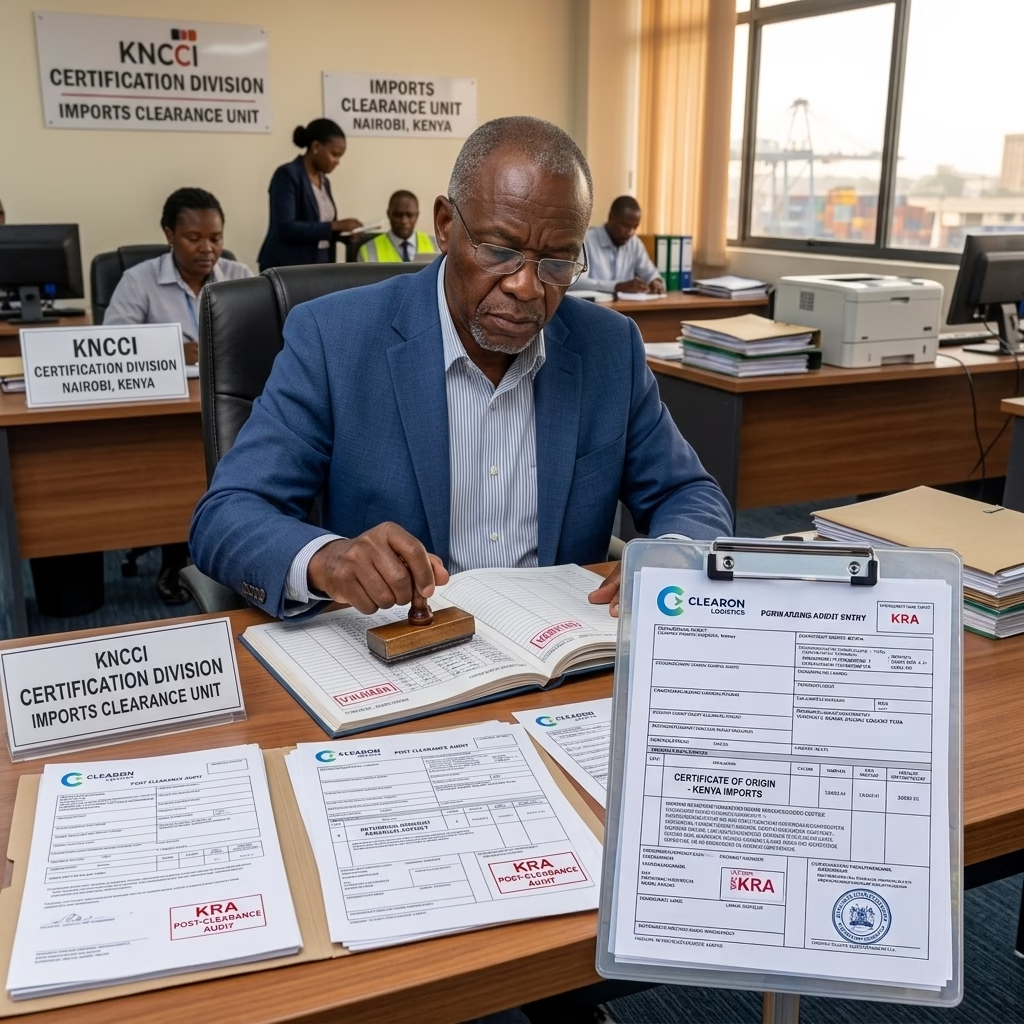
A Certificate of Origin Kenya imports now requires by law for every single consignment — a significant change most importers haven’t caught up with yet. If you imported into Kenya before mid-2025, there’s a good chance you never needed a Certificate of Origin (COO) unless you were specifically claiming a preferential tariff rate under an agreement like COMESA. That’s no longer optional. As of October 1, 2025, full enforcement began: every shipment entering Kenya must be accompanied by a valid Certificate of Origin, regardless of where it came from or whether you’re claiming any tariff preference at all.
Table of Contents
If your supplier, forwarder, or clearing agent hasn’t flagged this to you yet, it’s worth checking before your next shipment — because failure to comply is now a customs offence, with penalties and possible seizure of goods on the table.
Certificate of Origin Kenya Imports: What Changed, Specifically
Previously, a Certificate of Origin was a selective document — something you produced only if you wanted to benefit from a reduced duty rate under a regional or bilateral trade agreement (COMESA being the most common example). For an ordinary shipment with no preferential claim, standard documentation — the Import Declaration Form, commercial invoice, Bill of Lading or Airway Bill, Certificate of Conformity, and relevant permits — was generally sufficient.
The new rule removes that distinction entirely. The Certificate of Origin has gone from an optional instrument used to unlock preferential tariffs, to a universal prerequisite for customs clearance — required whether or not you’re claiming any preference at all.
Where the Certificate Needs to Come From
The COO must be issued by a competent authority recognised in the country of export — not generated informally by the exporter or supplier. In practice, this typically means a chamber of commerce, trade ministry, or equivalent recognised body in the country the goods are shipping from.
If you’re a Kenyan importer, this puts the practical burden on your relationship with your overseas supplier: you need to confirm they can produce a compliant COO from a recognised authority in their country, not just a generic document they’ve labelled “certificate of origin.”
What KRA Accepts If You Don’t Have One Yet
During the initial transition period, and in limited cases afterward, KRA allowed provisional clearance using substitute documents while a formal COO was being obtained. These alternatives included:
- An exporter’s origin declaration with detailed origin information
- An official export permit or licence from the exporting country
- A customs export declaration form from the country of origin
- A valid Pre-Export Verification of Conformity (PVoC) certificate issued by a KEBS agent
These substitutes are strictly for initial entry and remain subject to verification by customs — they are not a long-term workaround, and relying on them indefinitely is risky now that full enforcement is in effect.
Why This Matters More For Some Importers Than Others
- If you regularly claim preferential tariffs (COMESA, EAC, AGOA-linked, etc.), you likely already have a COO process in place — this change mostly formalises what you were already doing.
- If you’ve never claimed a preference and always paid standard duty, this is genuinely new territory. You now need a COO for shipments where you previously never thought about one.
- If you work with smaller or informal overseas suppliers, this is where the real risk sits — a supplier who’s never been asked for a COO before may not know how, or where, to get one from a recognised authority.
Practical Steps Before Your Next Shipment
- Ask your supplier directly whether they can provide a Certificate of Origin from a recognised authority in their country — don’t assume, confirm.
- Build the COO into your shipping timeline, not as an afterthought once goods are already en route.
- Confirm with your clearing agent what qualifies as a compliant COO for your specific origin country, since recognised issuing authorities vary by market.
- Don’t rely on substitute documents as a standing practice — they were designed as a transition bridge, not a permanent alternative.
The Cost of Getting This Wrong
Non-compliance is now explicitly treated as a customs offence. That means beyond the immediate clearance delay, importers risk penalties and, in serious cases, seizure of the goods entirely. For a business with a supply chain built around predictable shipping timelines, discovering this requirement only when a shipment is held at Mombasa or JKIA is an expensive way to learn about it.
At Clearon Logistics, we’ve already built the Certificate of Origin check into how we prepare every shipment — confirming with clients and their suppliers upfront, before cargo ships, not after it’s already sitting at the port. As a licensed and experienced clearing agency, staying ahead of regulatory changes like this one is part of the job we do quietly, so our clients don’t have to find out about them the hard way. You’ll hear about a requirement like this from us directly, with a clear explanation of what it means for your specific shipment — not buried in a customs notice you never saw.
Not sure if your supplier can produce a compliant Certificate of Origin? Talk to Clearon Logistics before your next shipment leaves origin.
Further Reading
- USDA FAS — New Certificate of Origin Requirement for Exports to Kenya (external, dofollow)
- Kenya Trade Information Portal — Certificate of Origin procedures (external, dofollow)
- Related on our blog: Essential Shipping and Customs Documentation in Kenya
- Related on our blog: HS Codes Explained: Why They Matter for Imports and Exports
- Our service: Clearing and Forwarding Services in Kenya
Frequently Asked Questions
Do I need a Certificate of Origin even if I’m not claiming a preferential tariff rate? Yes. As of full enforcement from October 1, 2025, every consignment entering Kenya requires a COO, regardless of whether you’re claiming any tariff preference.
Who issues a valid Certificate of Origin? A competent authority recognised in the country of export — typically a chamber of commerce or equivalent trade body in that country, not the exporter or supplier directly.
What happens if my shipment arrives without one? It’s treated as a customs offence, which can mean penalties or seizure of the goods. Some substitute documents were accepted during the transition period, but these are not a reliable long-term substitute.
Can my clearing agent help me get a Certificate of Origin? Your clearing agent can confirm what’s required and verify compliance, but the certificate itself must come from a recognised authority in the exporting country — this is usually something your supplier needs to arrange on their end.

Leave a Reply