
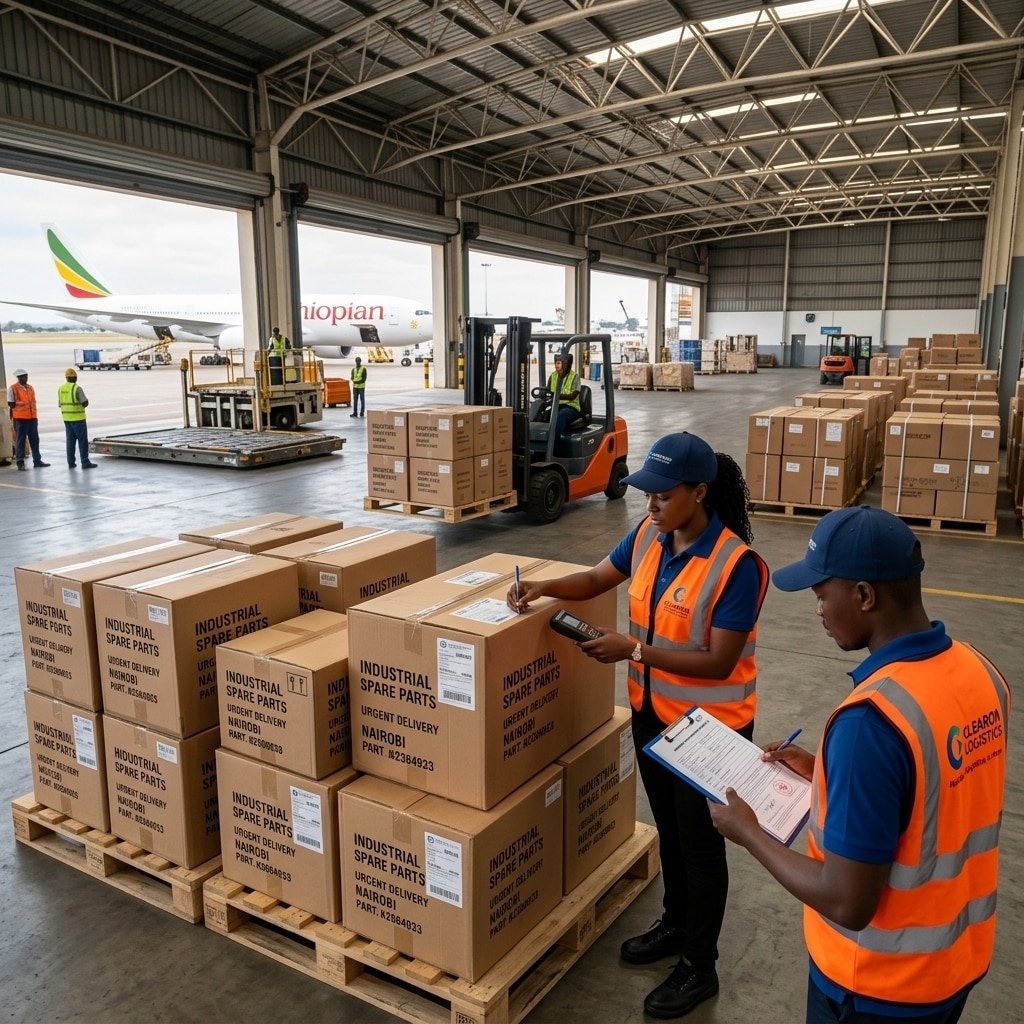
A clearing agent for industrial spare parts is judged on one thing above all: how fast a part gets from the supplier to the machine that’s down. Factories, mines, farms and processors lose money every hour a line is stopped, so spare-parts clearance has to be quick, accurate and low-drama. If you import replacement parts for plant and equipment, here is how to make sure the clearance side never becomes the bottleneck.
Table of Contents
When a Part Is Urgent, Every Day Is Downtime
Most urgent parts travel by air and are cleared at JKIA, where tight storage windows mean delay costs accumulate quickly. Our guide to clearing at JKIA explains how air cargo clearance differs from sea freight. Your agent should be able to lodge a declaration the same day your documentation is confirmed, not queue your parts behind routine work.
Duty Relief for Machinery Spare Parts
Industrial spare parts used for machines classified in HS chapters 84 and 85 can qualify for duty relief under the EAC’s exemption regime, generally by application and subject to conditions. That can save meaningful money for businesses that import parts regularly, but it only works if the relief is claimed correctly and supported by the right paperwork. Ask your agent whether your parts qualify and what evidence the application needs, and confirm current terms, since exemptions and stays are revised in each EAC gazette.
Classification: Part, Component or Whole Machine?
A replacement motor, a gearbox, a control board and a complete sub-assembly can each classify differently, and the wrong choice changes duty and permits. Always give your agent the part number, the machine model it fits and a plain-language description. Supplier invoices that say only “spare parts” are an invitation to delay. See our guide to HS codes.
Air Freight Logistics for Urgent Parts
For urgent items, build a repeatable routine: supplier sends documents before the flight departs, your agent pre-checks them, and the declaration is ready when the aircraft lands. Weigh air against sea for non-urgent restocking using our air versus sea freight comparison, and keep the Certificate of Origin and export declaration document requirements in the pre-flight checklist.
Repairs, Warranty Replacements and Returns
Parts and units that leave Kenya for repair and come back, or warranty replacements that arrive free of charge, still need correct declarations. Plan the outbound and inbound paperwork together, keep proof of the original import, and ask your agent how valuation and any relief apply. Zero-value shipments are still shipments, and treating them casually causes avoidable problems at clearance.
Keep a Standing Documentation File
Businesses that import parts repeatedly benefit from a standing file: machine serial numbers, models, previously agreed classifications and supplier details. It speeds up every future declaration and gives you consistent records if KRA ever reviews past imports, as it can under a post-clearance audit.
Working With Clearon Logistics on Spare Parts
We set up repeat importers with a standing process: parts classified once and recorded, documents checked before dispatch, and fast clearance at JKIA or the port. You always see an itemised quote, so duty relief, fees and levies are visible line by line.
Importing spare parts for plant and equipment? Talk to Clearon Logistics to set up a fast, repeatable clearance process before your next breakdown.
Frequently Asked Questions
Are industrial spare parts duty-free in Kenya? Spare parts for machinery in HS chapters 84 and 85 can qualify for relief under the EAC exemption regime, generally on application and subject to conditions. Confirm current eligibility for your parts.
Why is the supplier invoice description so important? Vague descriptions like ‘spare parts’ invite delay and reclassification. Part numbers and the machine model they fit let your agent classify correctly first time.
Should urgent parts always go by air? Usually, when downtime cost exceeds the freight premium. For planned restocking, sea freight is typically cheaper.
Do warranty replacements need customs declarations? Yes. Even free-of-charge replacements must be declared correctly, ideally with documentation linking them to the original import.
Further Reading
- Kenya Revenue Authority (external, dofollow)
- Kenya Airports Authority (external, dofollow)
- Related on our blog: Clearing Agent at JKIA
- Related on our blog: Air Freight vs Sea Freight to Kenya
- Related on our blog: HS Codes Explained
- Our service: Clearing and Forwarding Services in Kenya


Leave a Reply