
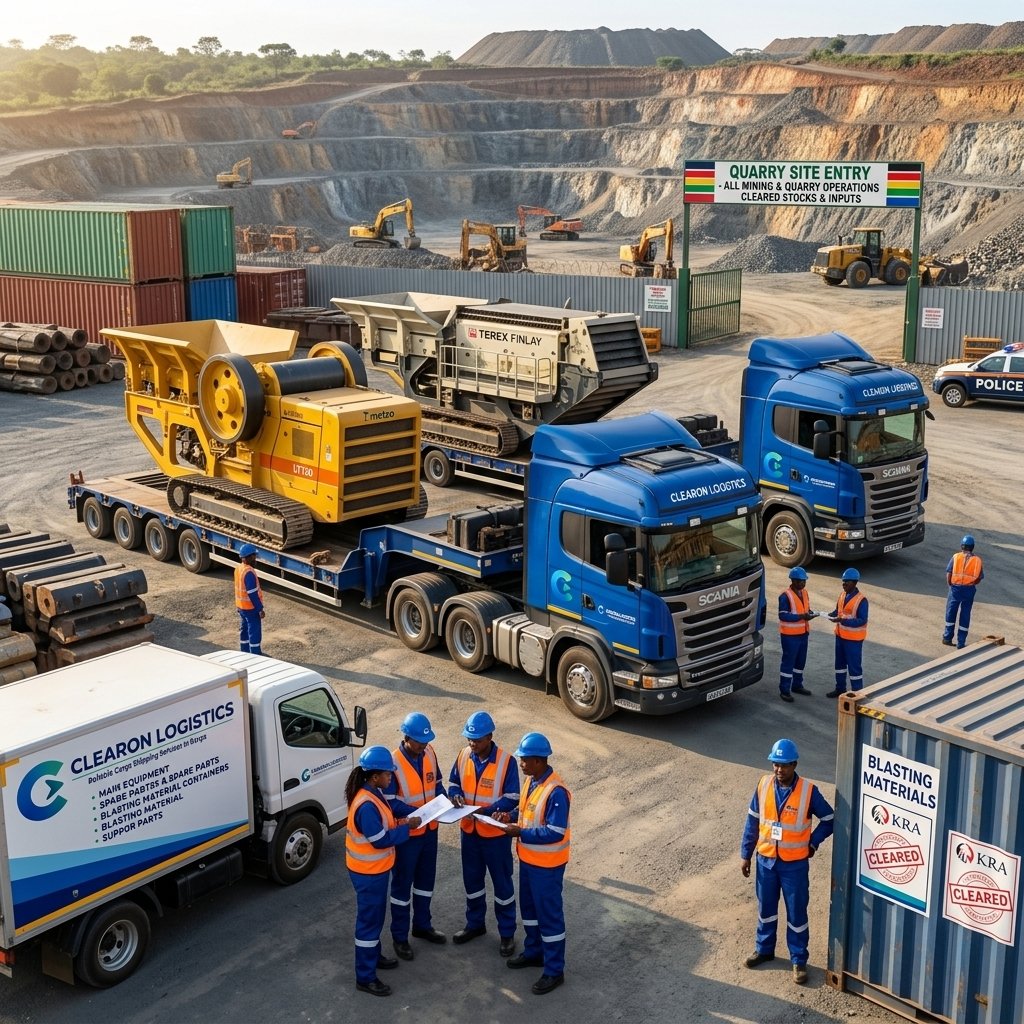
A clearing agent for mining and quarry operators handles cargo that is heavy, expensive and often hazardous, going to sites that are far from the port. Crushers, screens, drilling equipment, vehicles, conveyors and, for blasting operations, regulated explosives, all need to arrive in the right order and with the right authorisations. Mining is also a sector where a law dating from 1929 is being rewritten, so staying current matters.
Table of Contents
Plan Imports Around Your Licences
Mining operations in Kenya run under the Mining Act, 2016, with artisanal permits issued at county level and small-scale and large-scale licences issued nationally, plus separate dealer’s licences for anyone trading or exporting minerals. Equipment should be ordered against a licence that is in good standing, with the right to operate the site clearly established, since customs and financiers both ask. Our gemstone export guide explains the licensing structure.
Heavy Plant and Processing Equipment
Crushers, screens, excavators, loaders and haul trucks follow the classification, valuation and heavy-lift considerations in our construction equipment guide and machinery guide. For contractors bringing plant for a defined project, a temporary importation bond may be more appropriate than a permanent import. Used equipment needs strong condition and valuation documentation; see our used machinery guide.
Blasting Materials Are a Separate Compliance Track
Explosives are governed by the Explosives Act, with licences for magazines and permits for day-to-day transport, receipt and use. A Draft Explosives Bill 2026 would replace this framework, and industry has objected to proposed penalties and permit mechanics. Until it changes, current licences apply, and non-compliance risk is only growing. Our explosives guide covers the details; never ship blasting materials without confirming authorisations first.
Radiation Sources and Specialist Instruments
Some industrial gauges and radiography instruments contain radiation sources and require nuclear regulator authorisation, with short licence validity and separate operating licences; see our radiation sources guide. Treat any equipment with a radioactive source as a separate regulatory item, even if it ships alongside ordinary plant.
The Last Leg: Remote Sites and Axle Loads
Mine and quarry sites are often far from the port and reached by poor roads, so inland transport is typically the hardest and costliest leg. Plan loading, routing and permits together, and respect axle load limits, because a clean customs release can still be held at a weighbridge. See our bulk and breakbulk guide for specialised handling.
Documentation Pack for Mining and Quarry Imports
- Itemised invoice with model and serial numbers
- Mining licence or permit evidence supporting the end use
- Explosives licence or permit where blasting materials are involved
- KNRA licence for radiation sources
- Certificate of Conformity or exemption letter where applicable
- Certificate of Origin, export declaration document and Advance Cargo Declaration reference
- Condition and valuation support for used plant
- Local marine cargo insurance certificate
Working With Clearon Logistics for Mining and Quarry Clients
We plan sector shipments as projects: authorisations confirmed first, equipment classified and valued properly, and port-to-site transport coordinated around weight limits and site access.
Importing equipment or blasting materials for a mine or quarry? Talk to Clearon Logistics before your order ships, and we’ll map the authorisations and logistics for your cargo.
Frequently Asked Questions
Do mining operators need special approvals to import equipment? Equipment itself follows normal machinery rules, but explosives and radiation sources need separate authorisations, and your licences should be in good standing.
Can contractors import mining plant temporarily? Yes, under a customs bond for temporary importation, though Kenya doesn’t accept ATA Carnets and duty is payable if the plant isn’t re-exported on time.
Is the Explosives Act being replaced? A Draft Explosives Bill 2026 has been published, but current licences under the existing Act still apply until it changes.
Why is inland transport such a challenge for mining cargo? Sites are often remote with poor roads, and heavy loads must still comply with axle load limits.
Further Reading
- State Department for Mining (external, dofollow)
- Kenya Mining Cadastre Portal (external, dofollow)
- Related on our blog: Importing Explosives into Kenya
- Related on our blog: Clearing Agent for Construction Equipment Importers
- Related on our blog: Importing Radiation Sources into Kenya
- Our service: Clearing and Forwarding Services in Kenya






Leave a Reply