
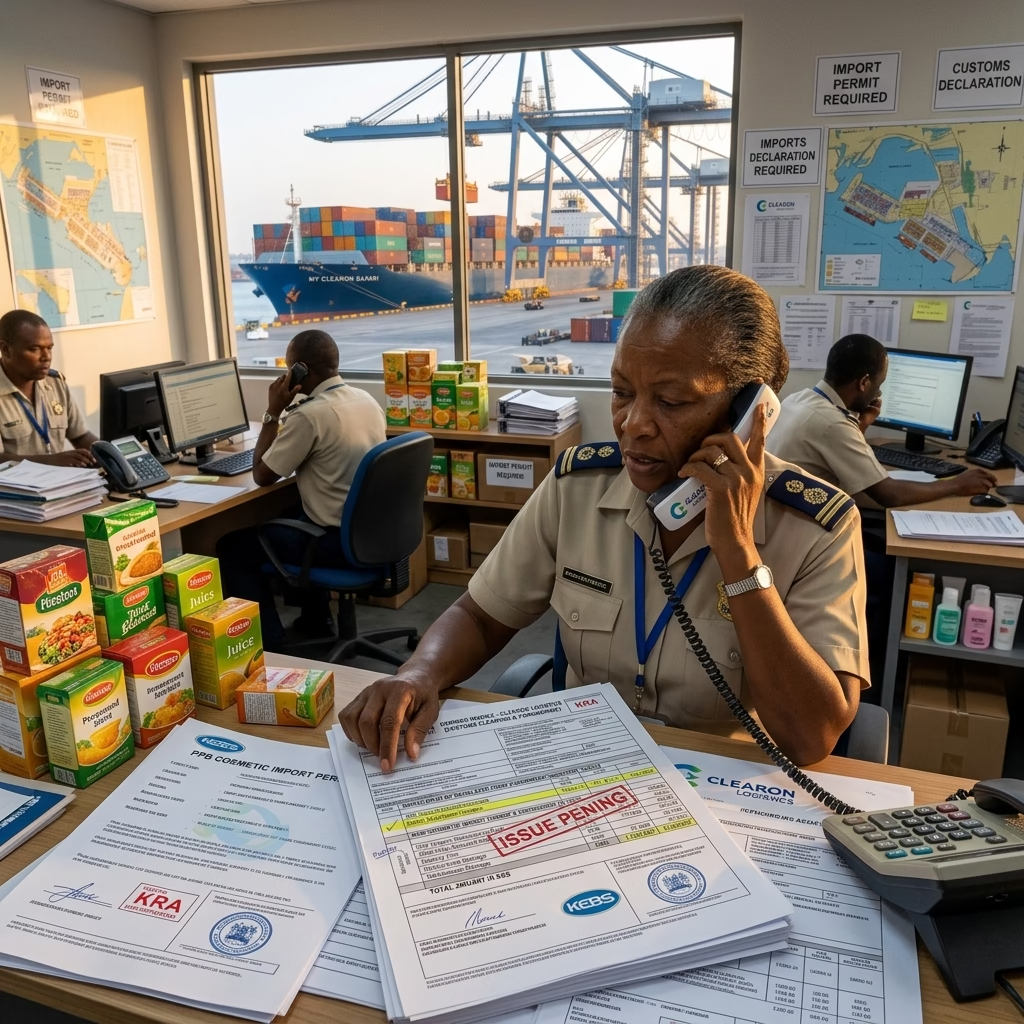
How a good clearing agent handles a problem shipment tells you more about their actual quality than anything they say when everything’s going smoothly. Every shipment carries some risk of something going sideways — a customs query, a documentation gap, an unexpected inspection, a delay outside anyone’s control. The agents worth trusting aren’t the ones who never encounter problems; they’re the ones who handle them in a way that keeps you informed and protected rather than exposed and guessing.
Table of Contents
Problems Are Normal — The Response Is What Matters
Given how many moving parts a shipment involves — supplier documentation, shipping lines, multiple government agencies, customs valuation, physical inspection — some percentage of shipments will hit a genuine snag, regardless of how experienced or careful the agent is. This isn’t a sign of incompetence; it’s a realistic feature of international trade. What actually separates a good agent from a bad one isn’t whether problems happen — it’s what happens in the hours and days after one does.
The First Thing a Good Agent Does: Tell You
This sounds obvious, but it’s the single most common failure point: an agent who discovers a problem and doesn’t tell you immediately, hoping to resolve it quietly before you notice. This might feel protective from the agent’s side, but it leaves you in the dark about your own shipment, unable to plan around a delay, unable to make an informed decision if one’s needed, and often finding out only once the problem has already gotten worse. A good agent tells you as soon as they know, even if they don’t yet have a solution — because you’re entitled to know what’s happening with your own cargo in real time, not on a curated timeline.
Ownership vs Deflection
When something goes wrong, there’s a meaningful difference between an agent who takes ownership of resolving it and one who spends energy explaining why it isn’t their fault. Sometimes a problem genuinely isn’t the agent’s doing — a supplier’s documentation error, a random customs inspection, a regulatory change nobody could have anticipated. Even then, a good agent’s posture is “here’s what happened and here’s what I’m doing about it,” not “this isn’t on me.” You hired an agent specifically to navigate these situations on your behalf — an agent who treats problem-solving as someone else’s job the moment things get difficult isn’t actually providing the service you’re paying for.
What Good Problem-Solving Actually Looks Like
- Diagnosing the actual issue quickly, rather than guessing or applying a generic fix
- Explaining the problem to you in plain terms, not vague reassurance that “it’s being handled”
- Presenting your realistic options, if there are any — different paths forward often carry different cost or timeline trade-offs, and you deserve to understand them
- Acting quickly once a path forward is clear, since delay compounds cost in almost every customs scenario — demurrage and storage charges don’t pause while a problem gets sorted out
- Keeping you updated at each step of the resolution, not just delivering a single “it’s fixed now” message once it’s over
When the Problem Is the Agent’s Own Mistake
This is the real test. An agent who made a genuine error — a documentation mistake, a missed permit, a miscalculated duty estimate — and owns it directly, explains what went wrong, and works to fix it (ideally without simply passing the entire cost of their own mistake onto you) is demonstrating exactly the kind of accountability worth valuing. An agent who obscures their own error, blames external factors that don’t hold up to scrutiny, or quietly tries to recover the cost from you without acknowledgment is showing you precisely why trust in this relationship matters as much as competence.
The Follow-Through After Resolution
A shipment that eventually clears despite a problem along the way isn’t automatically a success story — the way it’s handled shapes whether you’d trust that agent with your next shipment. A good agent follows up after resolution: confirming everything’s now correctly documented, explaining what caused the issue so it’s less likely to recur, and being straightforward about any cost or timeline impact rather than letting it quietly disappear into the final invoice. This follow-through is often the part clients remember most — not that a problem happened, but how completely and honestly it was closed out.
Why This Matters More Than a Smooth Track Record Alone
Any agent can look good during an uneventful shipment. The real evidence of quality shows up specifically when something doesn’t go according to plan — because that’s when an agent’s actual priorities, communication habits, and accountability become visible in a way marketing claims never can.
At Clearon Logistics, we treat a problem shipment as exactly the moment our value should be most obvious — telling clients immediately when something comes up, taking ownership of resolving it (including our own mistakes, if we make one), and following through until it’s genuinely closed out, not just quietly resolved and left unexplained.
Want to know how we’d actually handle a problem with your shipment, not just how we’d handle a smooth one? Talk to Clearon Logistics — ask us directly.
Frequently Asked Questions
Should I be worried if my clearing agent tells me a problem has come up with my shipment? Not necessarily — problems are a normal part of international trade given how many parties and processes are involved. What matters more is whether they tell you promptly and handle it transparently, rather than whether a problem occurred at all.
What should I do if my agent seems to be hiding a problem from me? Ask directly and specifically about your shipment’s current status, including whether anything unexpected has come up — a good agent will tell you honestly; continued vagueness or evasion is a genuine warning sign worth acting on.
How should an agent handle a mistake that was genuinely their own fault? By owning it directly — explaining what happened, what they’re doing to fix it, and being fair about any resulting cost — rather than obscuring the error or quietly passing its full cost onto you without acknowledgment.
Does a problem-free shipment mean an agent is definitely good? Not entirely — an uneventful shipment doesn’t fully test an agent’s communication, accountability, and problem-solving ability. How they handle something going wrong is often more revealing than how smoothly things go when nothing does.
Further Reading
- Kenya Revenue Authority — Customs & Border Control (external, dofollow)
- KRA Post-Clearance Audit: 5 Critical Steps to Protect Your Business (external, dofollow)
- Related on our blog: What a Clearing Agent Does: 5 Stages of Your Shipment Explained
- Related on our blog: Shipment Updates from Your Clearing Agent: 4 Standards to Expect
- Our service: Clearing and Forwarding Services in Kenya








Leave a Reply