
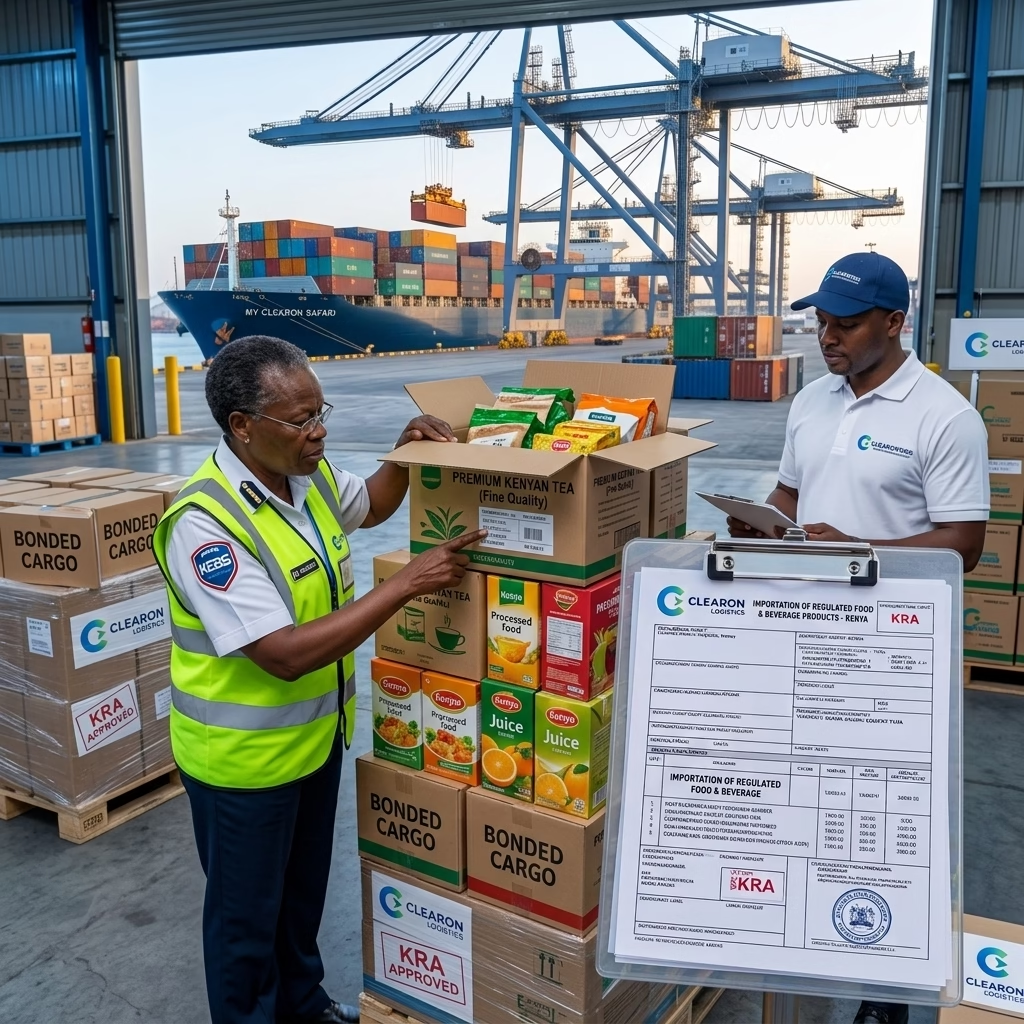
Importing food and beverage products into Kenya means answering to more than one regulator, often at the same time — and unlike some product categories, there’s no single agency that owns the whole process. Depending on exactly what you’re bringing in, you may need sign-off from KEBS, KEPHIS, the Directorate of Veterinary Services, the Kenya Dairy Board, the National Biosafety Authority, or the Department of Public Health, sometimes more than one at once.
Table of Contents
Why Food Imports Involve So Many Agencies
Kenya’s food import system is deliberately multi-sectoral, reflecting the reality that “food” covers everything from packaged snacks to live animals to genetically modified crops, each carrying different risks. The main regulators involved include KEBS (standards and labelling), KEPHIS (plant health), the Directorate of Veterinary Services (animal-derived products), the Kenya Dairy Board (dairy specifically), the National Biosafety Authority (genetically modified content), and the Department of Public Health, sometimes called the Port Health Office (general food safety at points of entry). All certification requests are submitted through the Kenya Electronic Single Window System, which at least consolidates the paperwork even where multiple agencies are involved.
The Certificate of Conformity Requirement
Regardless of which specific agencies apply to your product, a Certificate of Conformity (CoC), issued after Pre-Export Verification of Conformity (PVoC) inspection by a KEBS-appointed agent in the country of export, is mandatory for essentially all food exports to Kenya. This is the same PVoC framework that applies across many other regulated categories, and it needs to be arranged before shipment — a destination inspection instead of a pre-arranged certificate means added cost, delay, and risk for a category where spoilage during a hold-up is a genuine concern.
Kenya’s GMO Regulation — Not a Ban, But Tightly Controlled
This is worth flagging with an important update: Kenya lifted its decade-long ban on genetically modified crops and products back in October 2022. It is not currently a blanket prohibition — but that doesn’t mean GMOs move freely either. Under the National Biosafety Authority’s framework, only specifically approved GMO products can be imported, and clearance has become considerably more tightly enforced in recent months, with the National Biosafety Authority directing every port agency to check imports against an official approved-products list. Importers sourcing bulk grains, processed foods, or agricultural inputs from markets where GMO content is common in the general food supply need to confirm whether their specific product falls within an NBA-approved category — and if it does, that proper import clearance (separate from any market-placement approval) is in place — rather than assuming either an outright ban or unrestricted access.
Product-Specific Permits
Beyond the general CoC and GMO restriction, several food categories carry their own specific permit requirements:
- Meat, dairy, and poultry — import permits issued by the Directorate of Veterinary Services, alongside health certificates covering cleanliness, weight, and quality
- Fish — import permit or licence from the fisheries department, plus a health certificate from the exporting country’s relevant authority
- Plant-based products, cereals, grains, vegetables, and fruits — a Phytosanitary Certificate from KEPHIS
- Products requiring fumigation certification, depending on origin and product type
Each of these needs to be arranged in the country of export, meaning your supplier relationship and their familiarity with Kenyan import requirements matters as much as your own compliance planning.
Labelling Rules You Cannot Skip
KEBS labelling requirements for consumer-ready food products are specific and enforced. Expected information includes proper labelling in English (Kiswahili is common practice too, though English is the core requirement), full ingredient declaration, nutritional information, manufacturing and expiry dates, country of origin, net quantity, and allergen information. For alcoholic beverages specifically, packaging must carry at least two health warning messages, and the health warning must cover at least 30% of the package’s total surface area — a specific, measurable requirement that’s easy to get wrong if your supplier’s standard packaging was designed for a different market.
The Shelf-Life Rule Most Importers Miss
Here’s a detail that catches out even experienced importers: all imports with a limited shelf life must have more than 75% of their shelf life remaining from the date of expected landing in Kenya. This means a product with a 12-month shelf life needs to arrive in Kenya with at least 9 months still remaining — not simply be unexpired on arrival. Importers working with suppliers who ship close to production, without factoring in transit time plus this 75% buffer, risk a shipment that technically isn’t expired but still fails this specific import requirement.
Getting Food Imports Right From the Start
Between multiple regulatory agencies, product-specific permits, the GMO regulation, precise labelling rules, and the shelf-life requirement, food and beverage imports carry more moving compliance parts than most other categories — and because food has a limited shelf life, delays at the port carry a real cost in spoiled or wasted product, not just storage fees.
At Clearon Logistics, we help food and beverage importers map out exactly which agencies and permits apply to their specific product before it ships, confirm labelling meets Kenyan requirements ahead of production, and check shelf-life timing against realistic transit schedules — so a compliance gap doesn’t turn into a warehouse full of product you can’t legally sell.
Importing food or beverage products into Kenya? Talk to Clearon Logistics before you finalise packaging and shipping schedules with your supplier.
Frequently Asked Questions
Does Kenya allow the import of genetically modified food products? Kenya lifted its GMO import ban in October 2022, but this isn’t unrestricted access — only products specifically approved by the National Biosafety Authority can be imported, and enforcement of this approved-products framework has tightened considerably in recent months. Confirm whether your specific product falls under an approved category before shipping.
What’s the shelf-life rule for imported food products? Imports with a limited shelf life must have more than 75% of their shelf life remaining from the expected date of landing in Kenya — not simply be unexpired.
Which agency handles meat and dairy import permits? The Directorate of Veterinary Services issues import permits for meat, dairy, poultry, and related products, alongside required health certificates.
Do I need a Certificate of Conformity for every food product I import? Essentially yes — a CoC issued after PVoC inspection in the country of export is mandatory for food exports to Kenya, regardless of which other product-specific permits also apply.
Further Reading
- Kenya Bureau of Standards (KEBS) (external, dofollow)
- Kenya Plant Health Inspectorate Service (KEPHIS) (external, dofollow)
- Related on our blog: Prohibited and Restricted Goods Kenya: The Essential 2026 Import Checklist
- Related on our blog: What Happens If You Ship Goods to Kenya Without a Certificate of Conformity?
- Our service: Clearing and Forwarding Services in Kenya







Leave a Reply