
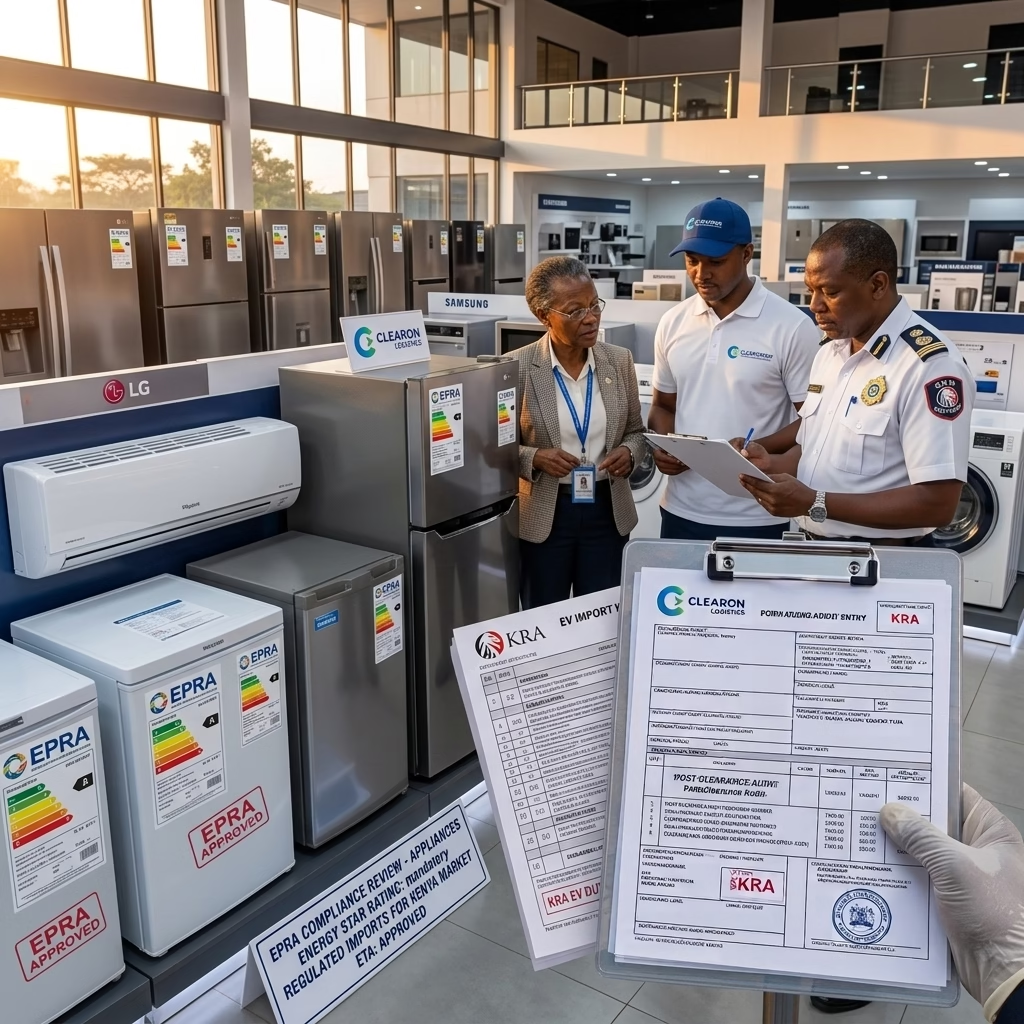
Importing household appliances into Kenya — refrigerators, air conditioners, lighting, motors — means satisfying a regulatory requirement that catches a surprising number of importers off guard: Minimum Energy Performance Standards, enforced by a regulator most people associate with fuel prices, not appliances. Ship a non-compliant model, and it’s not a labelling formality you can fix after the fact — it can mean the product simply isn’t authorised for sale in Kenya at all.
Table of Contents
The Regulator You Might Not Expect: EPRA
Most importers assume KEBS handles all product standards enforcement, but for a specific category of household appliances, the Energy and Petroleum Regulatory Authority (EPRA) is the relevant authority — the same body that regulates fuel prices and licenses solar PV vendors. EPRA’s mandate here comes from the Energy (Appliances’ Energy Performance and Labelling) Regulations 2016, which requires energy-consuming appliances — whether manufactured locally or imported — to meet Minimum Energy Performance Standards (MEPS) before they can legally be sold in Kenya.
Which Appliances Are Covered
EPRA’s Standards and Labelling programme, running since 2013, currently covers four main appliance categories:
- Refrigerators
- Air conditioners
- Motors
- Lighting (fluorescent lamps and related lighting equipment)
If your import falls into any of these categories, MEPS compliance isn’t optional — it’s a legal prerequisite for market entry, distinct from and in addition to standard KEBS product certification.
How the Registration Process Works
The compliance sequence works as follows:
- Testing — the specific appliance model must be tested through an EPRA-accredited laboratory against the applicable Kenyan Standard
- Model registration — the importer or manufacturer applies to register the tested model with EPRA once it meets the required performance threshold
- Energy label issuance — once registered, EPRA issues an energy label for the compliant model
- Label affixing — the manufacturer or importer is required to affix the energy label to the appliance before shipping or during manufacturing — not after the product has already arrived in Kenya
This sequencing matters: testing and registration are meant to happen well before a shipment departs, not as something to sort out once the goods are already at Mombasa Port or JKIA.
What Happened When Kenya Tightened AC Standards
Kenya’s history with air conditioner MEPS is a useful illustration of how seriously this is enforced. When revised, stricter AC standards took effect in April 2019, the new efficiency threshold immediately eliminated 73% of models previously on the Kenyan market — models that had been legally sold before the revision were no longer compliant afterward. Within six months, EPRA had registered 63 new models that met the tightened standard, and importers who adjusted their sourcing accordingly found compliant, energy-efficient units readily available from major supplying countries like China. The lesson for importers: MEPS thresholds can and do get revised, and a model that was compliant last year isn’t guaranteed to remain so.
The Energy Label Itself
The energy label isn’t just a compliance sticker — it’s a consumer-facing disclosure intended to help Kenyan buyers understand the running cost implications of a given appliance, similar in spirit to energy labels used internationally. For importers, this means the label needs to be genuinely accurate for the specific model and batch being sold, not a generic label copied across product variants that may perform differently.
How This Interacts With Other Import Requirements
MEPS compliance doesn’t replace other standard requirements for appliance imports — it sits alongside them:
- Standard KEBS Certificate of Conformity, arranged through the PVoC programme, still applies to appliance imports generally
- EPR Import Certificate requirements may also apply, particularly for appliances containing batteries or falling under broader Extended Producer Responsibility categories
- Correct HS code classification determines duty treatment separately from MEPS compliance
EPRA also works alongside KRA to restrict market entry of non-compliant appliances, meaning a gap in MEPS compliance can surface at multiple points in the import and distribution chain, not just at the port.
Getting Appliance Imports Right the First Time
Because MEPS testing and registration need to happen before shipment — and because standards can tighten with little warning, as the 2019 AC revision demonstrated — appliance importers benefit enormously from confirming their specific model’s compliance status well ahead of placing an order, rather than assuming last year’s compliant model is still compliant today.
At Clearon Logistics, we help appliance importers confirm EPRA MEPS status, KEBS certification, and any applicable EPR requirements before a shipment is placed — so you’re not the importer who finds out, container already at the port, that your model didn’t make the cut.
Importing refrigerators, air conditioners, motors, or lighting equipment into Kenya? Talk to Clearon Logistics to confirm current MEPS compliance before you order.
Frequently Asked Questions
Which household appliances currently require EPRA MEPS compliance in Kenya? Refrigerators, air conditioners, motors, and lighting equipment (fluorescent lamps) are the four main categories currently covered under EPRA’s Standards and Labelling programme.
Can MEPS standards change, making a previously compliant model non-compliant? Yes — when Kenya revised its air conditioner MEPS in 2019, 73% of previously available models on the market immediately became non-compliant. Standards can and do tighten over time.
Is EPRA registration the same as KEBS certification? No — they’re separate requirements. EPRA MEPS registration covers energy performance specifically, while KEBS certification covers broader product standards and conformity, arranged through the PVoC programme.
When does the energy label need to be affixed to the appliance? Before shipping or during manufacturing — not after the appliance has already arrived in Kenya, since registration and testing are meant to be completed well ahead of the shipment date.
Further Reading
- Energy and Petroleum Regulatory Authority (EPRA) — Standards and Labelling (external, dofollow)
- Kenya Bureau of Standards (KEBS) (external, dofollow)
- Related on our blog: Solar Equipment Import Kenya: Duty-Free Clearance in 2026
- Related on our blog: EPR Import Certificate Kenya: 5 Essential Facts
- Our service: Clearing and Forwarding Services in Kenya










Leave a Reply