
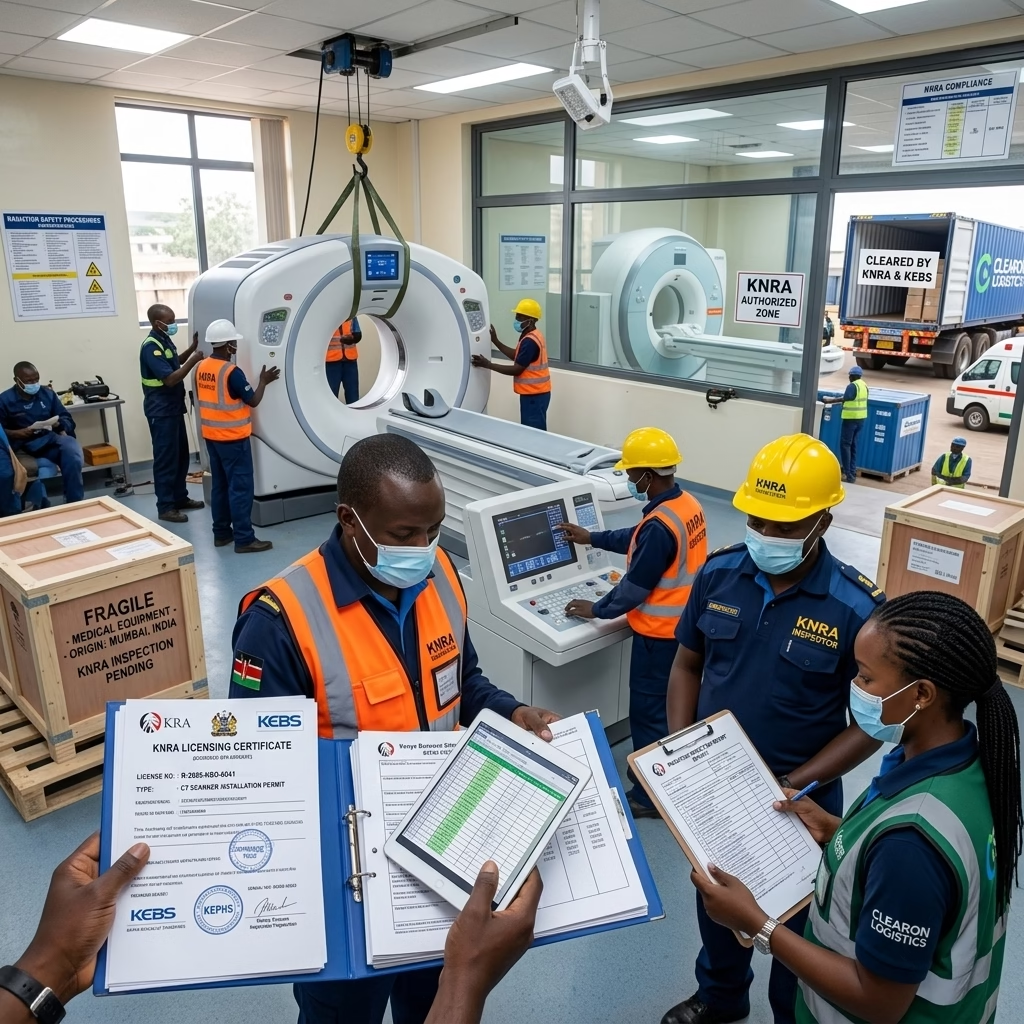
Importing medical or industrial equipment with radiation sources into Kenya — X-ray machines, CT scanners, industrial radiography equipment, certain research instruments — runs through an entirely separate licensing authority from anything else covered on our blog: the Kenya Nuclear Regulatory Authority (KNRA). If your equipment contains or generates ionising radiation, standard customs and KEBS compliance isn’t the whole picture — KNRA authorisation is a hard prerequisite, regardless of how routine the equipment might seem in a hospital or industrial setting.
Table of Contents
Why This Goes Well Beyond Nuclear Power
The word “nuclear” in KNRA’s name tends to suggest something exotic and rarely relevant — but the Authority’s actual regulatory scope is considerably broader than power generation. It covers radiation sources for industrial, research, and medical purposes, meaning it directly governs equipment that’s genuinely common in Kenyan hospitals, laboratories, and industrial facilities: diagnostic X-ray machines, CT scanners, radiotherapy equipment, industrial radiography devices used for materials testing, and various research instruments that use or generate ionising radiation.
The Legal Framework
Kenya’s radiation and nuclear regulatory framework runs through the Nuclear Regulatory Act No. 29 of 2019, which established KNRA, alongside the older Radiation Protection Act, Chapter 243. Under this framework, no person may import or export nuclear materials or radiation sources into or out of Kenya without KNRA authorisation — a requirement that applies regardless of whether the importer intends to own the equipment permanently, use it temporarily, or simply hold radioactive material as part of a broader shipment.
What Requires KNRA Authorisation
The Act’s definition of a regulated “activity” is deliberately broad, covering:
- Production, use, import, and export of radiation sources for industrial, research, or medical purposes
- Motor vehicles imported into Kenya
- Transportation of radioactive material
- Siting, construction, commissioning, operation, and decommissioning of facilities that use radiation sources
- Radioactive waste management activities and site remediation
A person or entity doesn’t need to already own a nuclear facility, radiation facility, or radioactive material to trigger the licensing requirement — simply intending to import equipment that contains or generates radiation is enough to bring KNRA’s authorisation process into play.
The Import Licence Process
To import a nuclear material or radiation source into Kenya, the applicant completes Form GKLRP 1, submitted to KNRA. A few specific conditions are worth knowing:
- The import licence is valid for 30 days — meaning the timing of your application needs to align closely with your actual planned shipment date, rather than being arranged far in advance and left sitting
- The applicant must confirm the receiving party in Kenya has all necessary approvals required by KNRA before the shipment proceeds
- Fees apply to every import and export licence application, calculated specifically rather than as a flat administrative charge
The Fee Is Calculated on Value, Not a Flat Rate
This is a detail worth knowing precisely: KNRA’s import licence fee is calculated at 1% of the CIF (Cost, Insurance, and Freight) value of the nuclear material or radiation source being imported — meaning the licensing cost scales directly with the value of your equipment, similar in principle to how standard customs levies are calculated on CIF value elsewhere in Kenyan trade. For high-value medical imaging equipment specifically, this fee should be factored into your overall landed cost calculation as a meaningful line item, not an afterthought.
Separate From Owning and Operating the Equipment
Import authorisation is only one part of the compliance picture. Separately, anyone intending to possess, use, or operate an irradiating device or radioactive material in Kenya needs their own licence (Form GKLRP 2), and individuals working directly with radiation sources — radiographers, radiation medicine specialists, radio-physicists — need to be licensed as authorised radiation workers in their own right (Form GKLRP 4). KNRA also conducts physical inspections of the premises where equipment will be used, assessing radiation safety and quality assurance before operational approval — meaning securing import clearance doesn’t automatically mean the equipment can be put into use immediately upon arrival.
Planning Around a Genuinely Specialised Requirement
Because the import licence’s 30-day validity window requires careful timing, and because import authorisation is only the first of several separate KNRA licences needed before equipment can actually be operated, this is a category where the regulatory sequence needs mapping out well before a shipment is booked — not treated as a standard customs matter with an extra form attached.
At Clearon Logistics, while KNRA licensing itself is a specialised process requiring direct engagement with the Authority, we help coordinate the customs and logistics side of importing radiation-source equipment — timing shipments around licence validity windows, and making sure standard customs documentation runs in parallel with, not ahead of or behind, your KNRA authorisation.
Importing medical imaging or industrial radiography equipment into Kenya? Talk to Clearon Logistics to coordinate your shipment timing around KNRA licensing requirements.
Frequently Asked Questions
Does KNRA authorisation only apply to nuclear power-related equipment? No — it covers any radiation source used for industrial, research, or medical purposes, including common equipment like X-ray machines, CT scanners, and industrial radiography devices.
How long is a KNRA import licence valid for? 30 days — meaning the application timing needs to align closely with your actual shipment date rather than being arranged well in advance and left unused.
How is the KNRA import licence fee calculated? At 1% of the CIF (Cost, Insurance, and Freight) value of the nuclear material or radiation source being imported, scaling with the value of the specific equipment.
Does an import licence mean I can immediately start using the equipment once it arrives? No — possessing and using an irradiating device or radioactive material requires its own separate licence, and KNRA conducts a physical premises inspection before operational approval is granted.
Further Reading
- Kenya Nuclear Regulatory Authority (KNRA) (external, dofollow)
- Kenya Law — Nuclear Regulatory Act No. 29 of 2019 (external, dofollow)
- Related on our blog: Importing Pharmaceuticals into Kenya: 5 Critical PPB Steps to Know
- Related on our blog: How to Calculate Your Landed Cost in Kenya
- Our service: Clearing and Forwarding Services in Kenya







Leave a Reply