Kenya’s Single Window System gets referenced constantly across import and export guidance — KenTrade, TradeNet, iCMS, NESWIS — often as if these are separate, competing platforms an importer needs to juggle. They’re not. They’re layers of the same underlying system, built over more than a decade, and understanding how they actually relate to each other makes the whole digital clearance process far less confusing.
Table of Contents
The Agency Behind It All: KenTrade
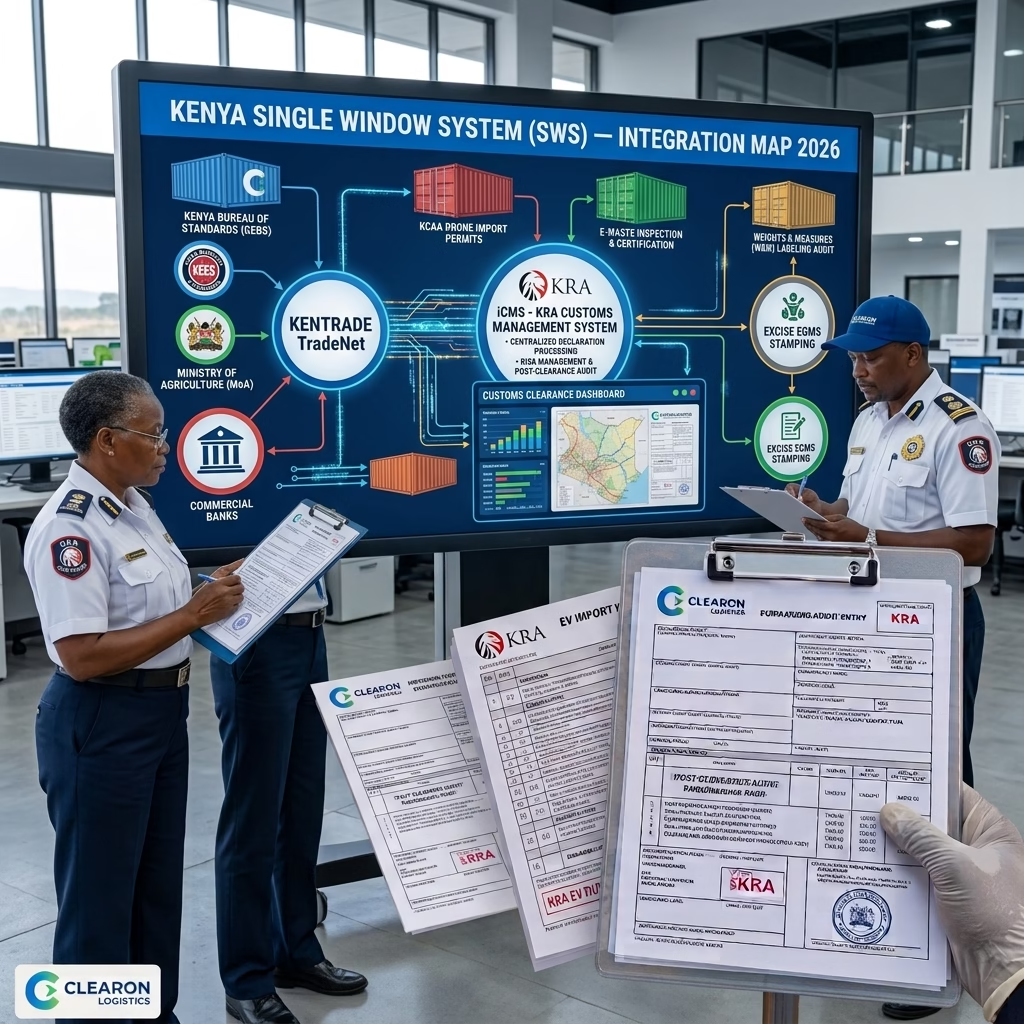
The Kenya Trade Network Agency (KenTrade) is the state corporation, under the National Treasury, mandated to establish, manage, and implement Kenya’s National Electronic Single Window System. Every other acronym in this space — TradeNet, NESWIS, the various module names — refers to a system KenTrade either built directly or manages in partnership with other agencies. If you’re trying to understand who’s actually responsible for Kenya’s digital trade infrastructure, KenTrade is the answer.
TradeNet: The Platform Itself
Kenya TradeNet System is the practical, day-to-day name for Kenya’s Single Window platform — the actual online portal where importers, exporters, clearing agents, and government agencies interact. It launched in Nairobi in May 2014 and serves as a single entry point for lodging import and export documents electronically, processing approvals, and making electronic payments for the fees, levies, and duties owed to government. Before TradeNet, Kenya’s trade digitisation sat at roughly 14% — by more recent measures, that figure has grown to around 94%, with the overwhelming majority of export and import processes now handled almost entirely paperless.
How Partner Government Agencies Fit In
This is the detail that explains why so many of the requirements covered across our blog — EPR certificates, KEBS certification, phytosanitary certificates, pharmaceutical permits — all seem to run through the “same” system despite coming from entirely different regulators. TradeNet brings together more than 35 government issuing agencies, known as Partner Government Agencies (PGAs), whose permits, licences, and certificates have been automated through direct system integrations or interfaces with TradeNet. In practice, this means a single platform lets KEBS, KEPHIS, the Pharmacy and Poisons Board, NEMA, and dozens of other regulators all process their specific requirements without an importer needing to visit each agency separately or juggle entirely disconnected systems.
TradeNet is also linked to financial institutions — banks and mobile payment platforms — through KRA’s iTax system and the government’s eCitizen platform, creating what’s designed to be an end-to-end electronic clearance chain from document submission through to payment.
iCMS: KRA’s Own System, Now Integrated
The Integrated Customs Management System (iCMS) is specifically KRA’s own customs processing platform, which replaced the older Simba system that ran for over a decade before it. Where this gets confusing for importers is that iCMS and TradeNet are now fully integrated — meaning a document or declaration processed through one increasingly flows through to the other, rather than requiring separate, duplicate submissions. This is why documents like your Import Declaration Form and the Advance Cargo Declaration are described in different places as being processed “through iCMS” and “through TradeNet” — both descriptions are accurate, because the systems are designed to work as one integrated pipeline rather than two competing platforms.
The Legal Foundation Changed in 2022
For years, Kenya’s Single Window operated under legal notices and administrative frameworks that had accumulated somewhat informally over time. This changed with the National Electronic Single Window System Act No. 25 of 2022, which formally established the legal basis for the system and confirmed KenTrade’s mandate in statute rather than administrative notice alone. This is also where the term NESWIS (National Electronic Single Window Integrated System) comes from in more recent documentation — referring to the same underlying platform, now operating under a firmer legislative foundation.
What This Means Practically for Your Shipment
For an importer or exporter, the practical takeaway is simpler than the acronym soup suggests:
- You’re generally dealing with one integrated system, even though different documents or permits within it might be described by different platform names depending on which agency issued them
- Registration with TradeNet is typically the starting point for most formal import/export documentation, whether you’re an importer, exporter, clearing agent, or courier service
- The system’s risk management module profiles cargo based on criteria like origin, cargo type, and importer history — meaning your compliance track record within the system can actually affect how much scrutiny future shipments receive, rewarding consistent, accurate declaration over time
- A gap in one PGA’s requirement — a missing EPR certificate, an incomplete phytosanitary certificate — can hold up the whole integrated clearance chain, even if every other agency’s requirement is satisfied
Why Understanding This Actually Helps
Most of the confusion importers experience with Kenya’s digital trade systems comes from treating each acronym as a separate hurdle to research individually, when in practice they’re facets of one connected infrastructure. Recognising that TradeNet, iCMS, and NESWIS are describing overlapping parts of the same system — rather than three things to master independently — makes the whole compliance picture considerably less overwhelming.
At Clearon Logistics, navigating this integrated system on behalf of clients is a core part of what we do day to day — coordinating submissions across the Partner Government Agencies relevant to your specific goods, so you don’t need to personally understand which acronym applies to which requirement, only that your shipment is moving correctly through the system as a whole.
Not sure how your shipment’s documentation flows through Kenya’s Single Window System? Talk to Clearon Logistics — we’ll handle the platform navigation so you don’t have to.
Frequently Asked Questions
Are KenTrade, TradeNet, and iCMS different systems I need to register with separately? Not entirely — KenTrade is the agency managing the system, TradeNet is the practical platform name for Kenya’s Single Window, and iCMS is KRA’s customs system, now fully integrated with TradeNet. You’ll typically register once and interact with an integrated pipeline rather than fully separate platforms.
What is a Partner Government Agency (PGA)? A PGA is any government body — KEBS, KEPHIS, the Pharmacy and Poisons Board, NEMA, and dozens of others — whose permits, licences, or certificates have been integrated into Kenya’s Single Window System, allowing their specific requirements to be processed through the same platform.
What does NESWIS stand for and is it different from TradeNet? NESWIS stands for National Electronic Single Window Integrated System — it refers to the same underlying platform as TradeNet, now operating under the legal foundation established by the National Electronic Single Window System Act No. 25 of 2022.
Does a compliance issue with one government agency affect my whole clearance? Yes — because the system is integrated, a missing or incomplete requirement from any single Partner Government Agency relevant to your goods can hold up your overall clearance, even if every other requirement has been satisfied.
Further Reading
- Kenya Trade Network Agency (KenTrade) (external, dofollow)
- Kenya Revenue Authority — iCMS (external, dofollow)
- Related on our blog: Import Declaration Form Kenya: What It Is and Why It Matters
- Related on our blog: Kenya’s 2026 Import Compliance Overhaul: Every Change in One Place
- Our service: Clearing and Forwarding Services in Kenya

Leave a Reply