

Finding a supplier overseas has never been easier.
A few clicks can connect a Kenyan business to thousands of manufacturers, wholesalers, and trading companies around the world.
You can search Alibaba, attend international trade exhibitions, contact manufacturers directly, or work with sourcing agents.
The problem is no longer finding suppliers.
The problem is identifying the right one.
A supplier may offer an attractive price, professional photographs, fast responses, and impressive product samples. Yet none of these guarantees that the supplier will deliver consistently once you place a large order.
For Kenyan importers, choosing the wrong supplier can create consequences that extend far beyond the purchase price.
You may receive products that don’t meet specifications.
Your shipment may be delayed.
Your customers may reject the goods.
You may discover that the packaging is unsuitable for international transportation.
You may even discover that the supplier’s documents are incomplete when your cargo is already on its way to Kenya.
The result can be lost money, delayed projects, unhappy customers, and significant pressure on your cash flow.
Successful importers therefore treat supplier selection as a strategic decision.
This guide explains how Kenyan businesses can evaluate overseas suppliers more intelligently and build supply chains that support long-term growth.
The Cheapest Supplier Is Not Necessarily the Best Supplier
Price is important.
No serious business ignores cost.
However, price should be only one part of the evaluation.
Imagine three suppliers offering the same product.
Supplier A charges $10 per unit.
Supplier B charges $11.
Supplier C charges $12.
At first glance, Supplier A appears to be the obvious choice.
But what if Supplier A:
- Takes twice as long to produce the goods.
- Has inconsistent quality.
- Uses weak packaging.
- Frequently makes documentation errors.
- Requires larger minimum orders.
- Communicates poorly after receiving payment.
Suddenly, the $2 difference between Supplier A and Supplier C becomes much less important.
The true cost of a supplier includes far more than the price on the quotation.
Think in Terms of Total Cost, Not Purchase Price
Experienced importers evaluate the total cost of acquiring and selling a product.
This can include:
- Product purchase price.
- Supplier handling charges.
- Packaging costs.
- Local transportation.
- International freight.
- Customs-related costs.
- Inland delivery.
- Storage.
- Product losses or damage.
- Quality control.
- Delays.
A supplier offering a slightly higher unit price may ultimately produce a lower total cost if the entire supply chain operates more efficiently.
This is why procurement professionals often evaluate the total landed cost rather than simply comparing supplier quotations.
The First Question: Is the Supplier Actually a Manufacturer?
One of the first things an importer should understand is who they are dealing with.
A supplier may be:
- A manufacturer.
- A wholesaler.
- A trading company.
- An export agent.
- A sourcing intermediary.
None of these is automatically better than the others.
The important question is whether the supplier’s business model matches your needs.
For example, a retailer importing small quantities may benefit from working with a wholesaler.
A company requiring large volumes and customised products may prefer a manufacturer.
Understanding the difference helps you negotiate better and set realistic expectations.
Ask the Right Questions Before Placing an Order
Before making a significant purchase, Kenyan importers should ask detailed questions.
For example:
Product Questions
- What materials are used?
- What are the exact specifications?
- What quality standards are followed?
- Are customisations available?
Production Questions
- What is the minimum order quantity (MOQ)?
- What is the production lead time?
- How much production capacity is available?
- Can the supplier handle larger future orders?
Packaging Questions
- How are products packaged?
- How many units fit into one carton?
- What are the carton dimensions?
- How much does each carton weigh?
These questions are not merely technical.
They directly affect your logistics costs.
Packaging Can Change Your Shipping Economics
Two suppliers can sell identical products at identical prices but produce completely different shipping costs.
Consider a simple example.
Supplier A packages 100 units in ten cartons.
Supplier B packages the same 100 units in five cartons using more efficient packaging.
If Supplier B’s packaging reduces the overall cargo volume significantly, the shipping cost per unit may be lower.
For sea freight, cargo volume can influence the economics of consolidated shipments.
For air freight, both actual and volumetric weight may affect the final cost.
This means packaging should be discussed before purchasing—not after the goods have already been manufactured.
Don’t Ignore Product Dimensions
Importers often focus on:
- Unit price.
- Quantity.
- Product weight.
But dimensions can be equally important.
A product may be lightweight but occupy significant space.
Another may be heavy but compact.
Understanding dimensions before placing an order helps you estimate the likely logistics requirements and determine whether consolidation, air freight, or sea freight is more suitable.
This is particularly important when importing multiple products from different suppliers.
Supplier Communication Is a Business Asset
One of the easiest ways to evaluate a supplier is to observe how they communicate before receiving your money.
Do they answer questions clearly?
Do they provide documentation promptly?
Do they understand your specifications?
Do they admit when they don’t know something?
Do they provide consistent information?
A supplier who communicates poorly before receiving payment may become even harder to deal with after receiving it.
Communication is not a soft skill in international trade.
It is a risk-management tool.
Always Confirm What You Are Actually Buying
Many disputes begin because the buyer and supplier have different interpretations of the product specifications.
Never rely entirely on photographs.
Confirm:
- Materials.
- Dimensions.
- Colours.
- Finishes.
- Performance specifications.
- Packaging.
- Quantity.
- Branding requirements.
For customised products, written specifications are especially important.
The more expensive the order, the more important documentation becomes.
Samples Are Useful—But Samples Are Not Guarantees
Ordering a sample is an important step.
It allows you to evaluate:
- Product quality.
- Materials.
- Finishing.
- Packaging.
- Functionality.
However, a sample only proves what the supplier can produce once.
It does not necessarily prove that every future production batch will meet the same standard.
For larger orders, businesses should consider quality control procedures that verify production consistency.
Start Small Before Going Big
One of the safest approaches for a new importer is to test a supplier with a smaller order.
This allows you to evaluate:
- Product quality.
- Production reliability.
- Communication.
- Packaging.
- Documentation.
- Delivery performance.
If the supplier performs well, you can gradually increase order volumes.
A small initial order can reveal problems before they become expensive problems.
Verify Business Information Where Possible
Before making substantial payments, businesses should conduct reasonable due diligence.
Depending on the supplier and country, this may include checking:
- Company registration information.
- Business address.
- Export history.
- Certifications.
- References.
- Online presence.
No verification method eliminates all risk.
However, due diligence reduces the possibility of making decisions based solely on a supplier’s marketing claims.
Be Careful With Payment Terms
Payment terms deserve serious attention.
Some suppliers request full payment before production.
Others may offer staged payments.
For larger orders, businesses should carefully consider how payment arrangements affect risk and cash flow.
For example, an importer may negotiate:
- An initial deposit.
- A production milestone payment.
- A final payment after quality verification.
The specific arrangement will depend on the supplier, industry, and transaction.
The important principle is simple:
Payment terms should be evaluated as part of supplier risk management.
Incoterms Can Change Your Responsibilities
International purchases are often quoted using Incoterms such as:
- EXW
- FOB
- CIF
- DAP
These terms determine which party is responsible for different aspects of transportation, costs, and risk.
A supplier offering a lower price under one Incoterm may not actually be offering a cheaper deal once all additional responsibilities are considered.
Kenyan importers should understand exactly what is included in any quotation before comparing it with another supplier’s offer.
Don’t Forget the Logistics Before Choosing the Supplier
This is where procurement and logistics intersect.
Suppose you are buying from five different suppliers in China.
Supplier A is located in Shenzhen.
Supplier B is in Guangzhou.
Supplier C is in Yiwu.
Supplier D is in Shanghai.
Supplier E is elsewhere.
Each supplier may offer excellent prices.
But now you have five separate shipments that need to be coordinated.
For a small importer, managing these independently may create unnecessary complexity.
A consolidation strategy may be more practical.
With consolidation, suppliers can deliver goods to a designated warehouse, where cargo from different suppliers is received and combined before being shipped to Kenya.
This can simplify the logistics process and make it easier to manage multiple suppliers within one overall shipment.
Supplier Selection Should Consider Your Future Growth
The right supplier today may not be the right supplier three years from now.
As your business grows, your requirements may change.
You may need:
- Larger production capacity.
- Better quality control.
- Faster lead times.
- Custom packaging.
- Private labelling.
- More favourable payment terms.
When evaluating suppliers, consider whether they can grow with you.
A supplier who can reliably handle 100 units may not necessarily be capable of producing 10,000 units.
Build Relationships, Not Just Transactions
International trade becomes easier when trust develops between buyers and suppliers.
Long-term relationships can improve:
- Communication.
- Production planning.
- Quality consistency.
- Negotiations.
- Problem resolution.
However, relationships should never replace proper controls.
Trust and verification should work together.
What Happens After You Choose Your Supplier?
Choosing the supplier is only the beginning.
Once the order is placed, the next challenge is coordinating the movement of goods from the supplier to Kenya.
This may involve:
- Supplier dispatch.
- Warehouse receiving.
- Cargo consolidation.
- Export documentation.
- Freight booking.
- International transportation.
- Customs clearance.
- Inland delivery.
A supplier can produce an excellent product and still leave you with a difficult logistics problem if the shipping process is not planned properly.
How Clearon Logistics Helps Kenyan Importers
At Clearon Logistics, we understand that international shipping begins before cargo starts moving.
For businesses importing from China, we support both consolidated and direct shipments.
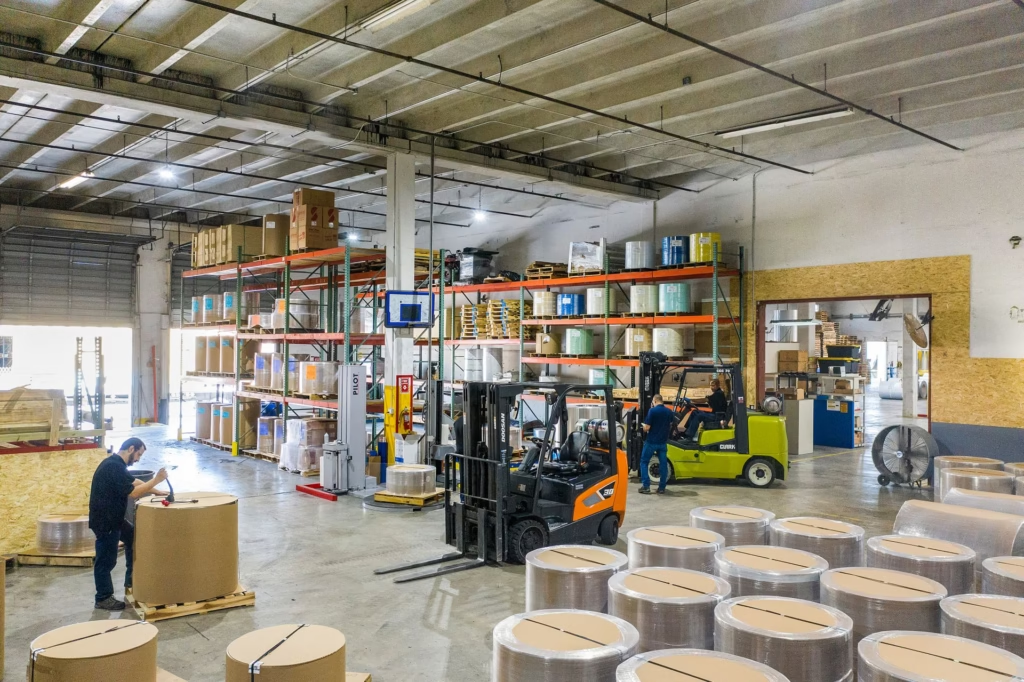
For smaller shipments, suppliers can deliver cargo to our warehouse in China, where goods from different customers can be received and consolidated before shipment to Kenya.
This model can be particularly useful for businesses buying from multiple suppliers or importing smaller quantities.
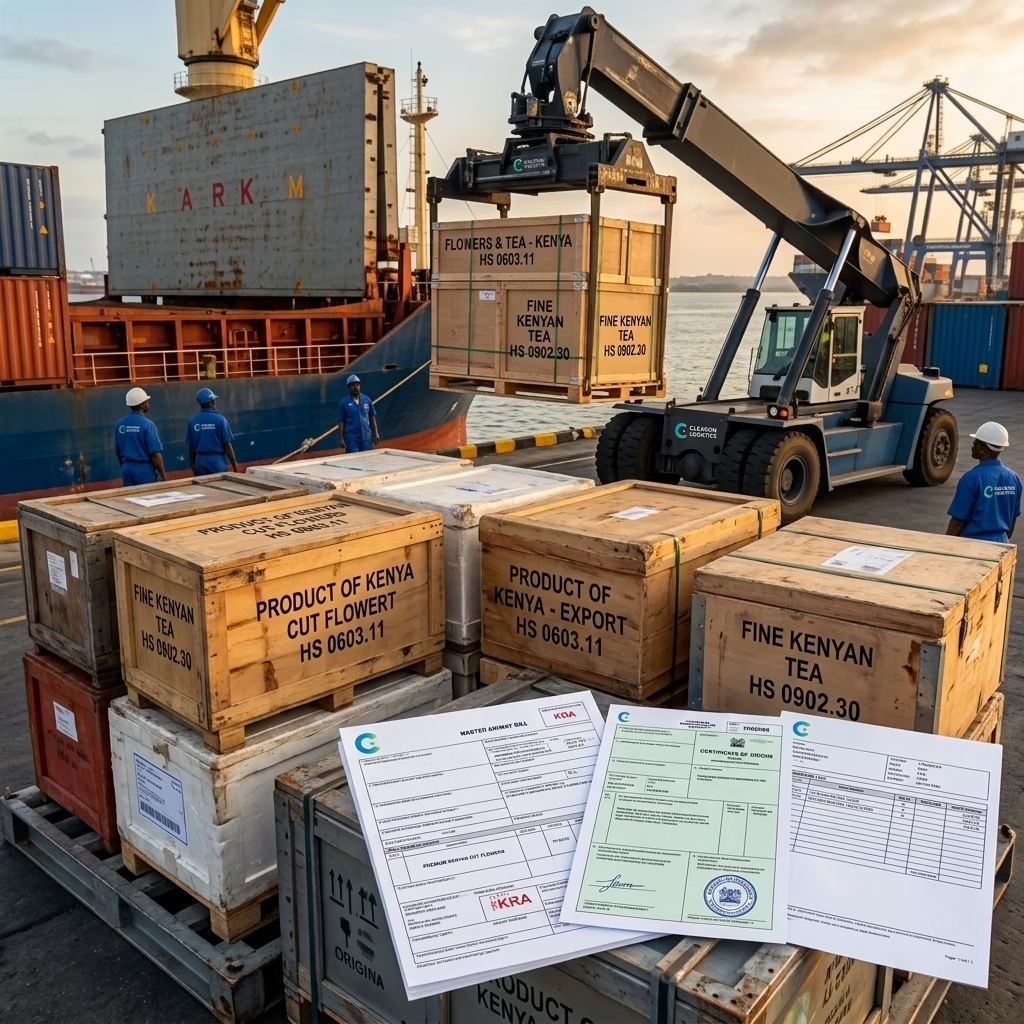
For larger shipments, including full container loads and larger air consignments, we can coordinate the shipping process with the client, including vessel scheduling, booking, documentation, customs clearance, and cargo release.
We also support businesses importing from the United Kingdom, United States, Dubai, and other international markets.
The objective is simple:
Make the journey from overseas supplier to Kenyan business more organised, predictable, and manageable.
Final Thoughts
Choosing an overseas supplier is one of the most important decisions a Kenyan importer can make.
The wrong supplier can create problems that affect your entire business.
The right supplier can become a valuable long-term partner that supports growth, improves consistency, and strengthens your competitive position.
Don’t choose suppliers based solely on price.
Evaluate quality.
Evaluate communication.
Evaluate production capacity.
Evaluate packaging.
Evaluate payment terms.
Evaluate logistics.
Most importantly, evaluate the supplier based on the total value they can bring to your business.
And remember that a successful international purchase does not end when the supplier ships your goods.
The real objective is to get the right products, in the right condition, at the right cost, to the right destination, at the right time.
That requires coordination across the entire supply chain.
At Clearon Logistics, we help Kenyan businesses navigate that journey by combining international freight coordination, cargo consolidation, customs clearance, and final delivery into a more connected logistics process.
Because choosing the right supplier is important.
But building the right supply chain is what turns a good purchase into a successful business outcome.

Leave a Reply