One of the most expensive mistakes an importer can make is discovering a regulatory requirement after the goods have already left the country of origin.
At that point, the supplier has been paid.
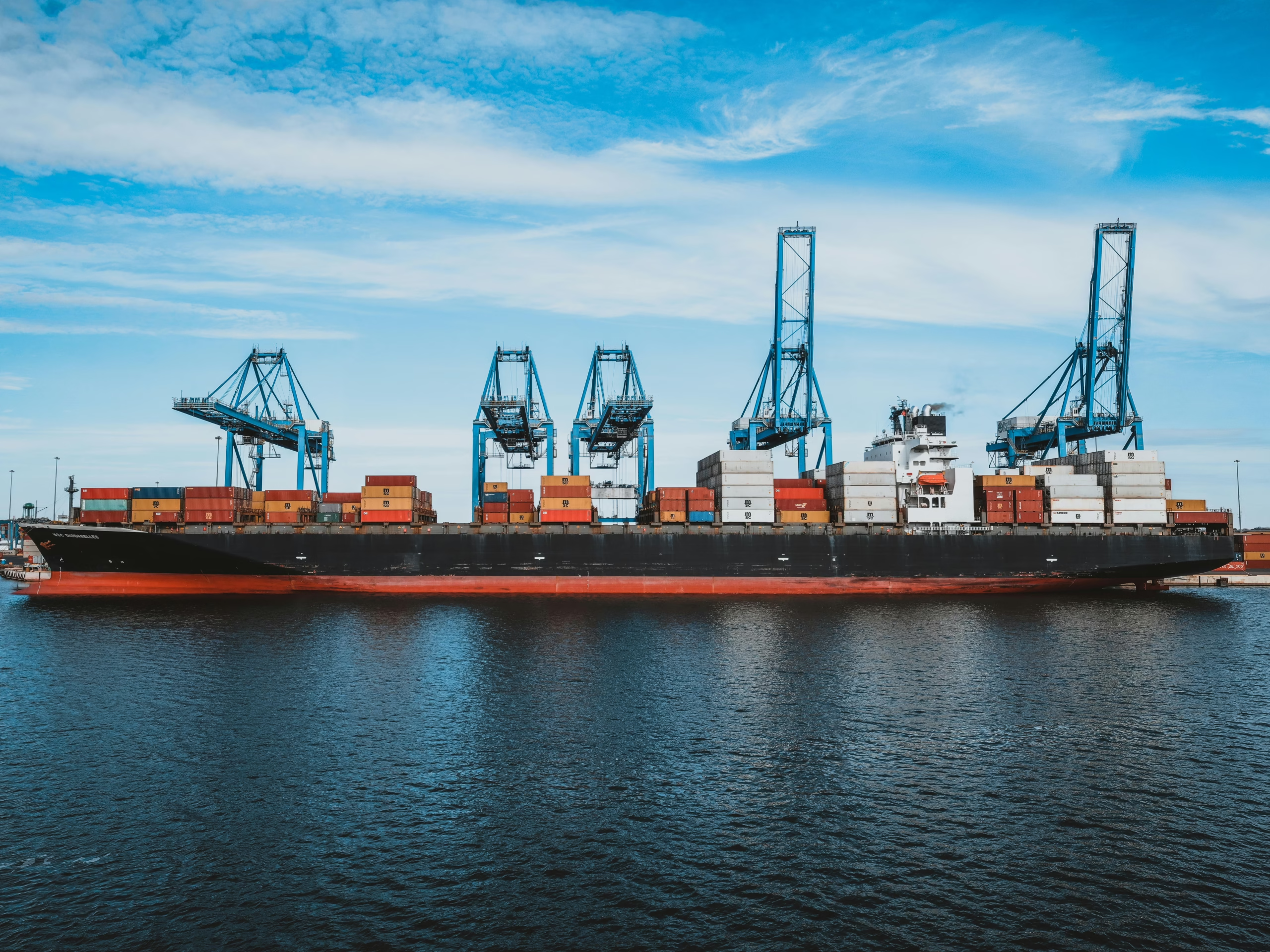
The cargo is already on the water.
The vessel is moving toward Kenya.
And suddenly, the importer discovers that a document required for customs clearance was supposed to be obtained before shipment.
This situation can create unnecessary costs, delays, and significant stress.
For businesses importing commercial goods into Kenya, understanding the Certificate of Conformity (CoC) and the Pre-Export Verification of Conformity (PVoC) process is therefore extremely important.
The issue becomes even more significant when importing machinery, industrial equipment, electrical products, construction materials, electronics, and other goods that may fall under applicable KEBS standards and conformity requirements.
Importers should understand regulatory requirements before their cargo leaves the country of origin.
What Is a Certificate of Conformity?
A Certificate of Conformity, commonly referred to as a CoC, is a document used to demonstrate that applicable imported goods meet relevant standards and conformity requirements for the destination market.
For goods subject to Kenya’s PVoC programme, conformity verification is generally undertaken before shipment from the exporting country.
The objective is to ensure that products entering Kenya meet the required standards.
The exact requirements can vary depending on:
- Product category
- Country of origin
- Applicable standards
- Current regulatory requirements
- Whether the goods fall under a regulated PVoC programme
This means importers should not assume that every shipment follows exactly the same process.
Why the Timing of PVoC Matters
One of the most important things importers need to understand is that conformity verification is not simply a document you obtain when your container arrives at Mombasa.
For applicable goods, the verification process is designed to take place before shipment.
This means the process needs to be considered while the cargo is still at the country of origin.
For an importer sourcing from China, for example, the compliance process should be considered before the supplier loads the container and before the vessel departs.
Once the cargo is already on the water, some origin-side procedures may no longer be possible.
This is precisely what happened in the recent machinery shipment handled by Clearon Logistics.
Case Study: A 40ft Container from China
The customer had imported a 40ft container from China containing:
- A fiber laser cutting machine
- An NC bending machine
The machinery was already loaded onto the vessel.
The vessel had already departed China.
Only after this stage did the customer engage Clearon Logistics to manage the customs clearance process in Kenya.
During our review of the shipment, we identified a problem.
The required PVoC process had not been completed before the goods left China.
This meant the customer could no longer follow the normal origin-based inspection route for the shipment.
The issue now had to be addressed at destination.
The Financial Consequence of the Problem
Because the required conformity process had not been completed at origin, the importer had to undergo the applicable destination inspection process.
This resulted in an additional financial burden.
In this particular case, the customer incurred a 5% penalty based on the customs value associated with the destination inspection process.
This additional cost could have been avoided if the shipment had been reviewed before the container left China and the necessary conformity process had been completed at the appropriate stage.
This is a powerful lesson for Kenyan importers.
The cost of compliance is often much lower than the cost of correcting non-compliance.
Why Importers Should Not Rely Entirely on Suppliers
A common mistake among first-time importers is assuming that the overseas supplier understands all Kenyan import requirements.
A supplier in China may be highly experienced in exporting goods.
However, that does not automatically mean they understand:
- Kenyan customs procedures
- KEBS requirements
- PVoC requirements
- Import documentation
- IDF procedures
- Tariff classification
- Kenyan tax requirements
The supplier’s responsibility is primarily to manufacture and export the goods according to the agreed terms.
The importer must ensure that the shipment can legally and efficiently enter Kenya.
This is why it is important to involve professionals who understand the destination market.
What Happens When the Goods Are Already on the Vessel?
This is one of the most common questions importers ask.
The answer depends on the specific goods and regulatory requirements.
There is no universal solution for every shipment.
The first step is to determine exactly what is missing.
An experienced clearing and forwarding partner can review:
- Commercial invoice
- Packing list
- Bill of lading
- Product description
- Import documentation
- Applicable regulatory requirements
The objective is to identify the available options before the vessel arrives.
This is extremely important.
A shipment should not be allowed to arrive at the port without a clear understanding of what will happen next.
Early Documentation Preparation Can Save Time
Although the PVoC issue in this particular case could not be reversed, Clearon Logistics focused on everything else that could be prepared in advance.
We began preparing the required documentation while the cargo was still in transit.
This included securing IDF approval before the cargo arrived and preparing for the remaining customs and regulatory procedures.
This approach allowed the clearance process to move forward efficiently once the shipment became available.
The lesson is simple.
Even when one problem cannot be reversed, good preparation can prevent additional problems from developing.
Customs Clearance Is About More Than Paying Taxes
Some importers assume that once they have paid the required taxes, their container is automatically ready for release.
In reality, customs clearance involves several interconnected processes.
Depending on the shipment, these may include:
- Documentation review
- Customs declaration
- Valuation
- Tariff classification
- Tax assessment
- Payment of applicable taxes
- Regulatory compliance
- Inspection
- Customs verification
- Release processing
A problem in any one of these areas can delay cargo release.
This is why clearance should be treated as a process rather than a single transaction.
Understanding Import Duty Is Also Important
The machinery in this particular shipment had an important financial advantage.
The applicable import duty on the machines was zero based on the relevant tariff treatment.
However, this does not mean that every machine imported into Kenya automatically attracts zero import duty.
The actual tax treatment depends on factors such as:
- Correct HS classification
- Product specifications
- Applicable customs rules
- Current tax regulations
- Any exemptions or special provisions
Importers should therefore avoid making assumptions based solely on the fact that the product is described as “machinery.”
Two seemingly similar products may have different classifications and different tax treatment.
Professional assessment before shipment is advisable.
The Difference Between Duty-Free and Tax-Free
This distinction is often misunderstood.
A product attracting zero import duty does not necessarily mean the importer pays nothing.
Other applicable taxes, levies, fees, and regulatory charges may still apply e.g VAT 16%, RDL 2%, and IDF 2.5%.
The total landed cost of an imported machine can include several components.
For example:
Purchase Price + International Freight + Insurance + Import Duty + Applicable Taxes + Regulatory Charges + Port Costs + Clearance Costs + Inland Transport
Therefore, importers should calculate the complete landed cost before committing to a purchase.
What First-Time Importers Should Do Before Shipping
If you are importing into Kenya for the first time, don’t wait until your supplier says:
“Your container has shipped.”
Start earlier.
Before paying the final balance or authorising shipment, consider reviewing:
Product Classification
Understand how the goods are likely to be classified for customs purposes.
Regulatory Requirements
Determine whether the goods are subject to KEBS conformity requirements or other regulatory controls.
PVoC Requirements
Establish whether the goods require pre-export verification and what must be completed before shipment.
Import Documentation
Ensure that the necessary documents are prepared correctly.
Taxes and Duties
Estimate the applicable customs taxes and other costs.
Shipping Method
Determine whether the shipment is better suited to consolidation, FCL, or air freight.
Delivery
Plan how the cargo will move from Mombasa to its final destination.
This preparation can prevent expensive surprises.
What Regular Importers Should Do Differently
Businesses importing frequently should not approach every shipment as a new project.
Instead, they should create standard operating procedures.
For example, a company importing machinery regularly could establish a process where every purchase is reviewed before the supplier ships.
The internal checklist could include:
- Product description confirmed
- HS classification reviewed
- PVoC requirement checked
- Required certificates identified
- Import documents prepared
- IDF process initiated
- Freight arrangements confirmed
- Clearance partner notified
- Delivery arrangements planned
This creates consistency.
It also reduces the risk of relying on memory or assumptions.
The Best Time to Involve a Clearing Agent
There are three stages at which an importer can engage a clearing and forwarding company.
Stage One: Before Buying
This is ideal.
The logistics partner can help identify potential compliance, tax, and shipping considerations before the purchase is finalised.
Stage Two: Before Shipping
This is still very good.
The shipment can be reviewed before the supplier loads the goods.
Any missing compliance requirements can potentially be addressed before departure.
Stage Three: After the Vessel Has Departed
This is where problems become more complicated.
Some processes may no longer be possible at origin.
Alternative procedures may need to be followed.
Additional costs may arise.
The Biggest Lesson for Kenyan Importers
The most important lesson is not simply:
“Get a Certificate of Conformity.”
The broader lesson is:
Understand your import requirements before your cargo leaves the country of origin.
A clearing agent should not be the person you call only when your container is already at Mombasa.
A good logistics partner should ideally be involved before the supplier ships.
This allows potential problems to be identified while there is still time to address them.
Clearon Logistics: Helping Importers Avoid Costly Surprises
At Clearon Logistics, we work with both first-time and experienced importers.
Our role is to help businesses navigate the complexities of international shipping and importing into Kenya.
We support clients with services that can include:
- Shipping coordination
- Cargo consolidation
- Full container shipments
- Air freight
- Import documentation
- IDF processing
- Customs clearance
- KEBS-related compliance coordination
- Port clearance
- Inland transportation
- Final delivery
Our recent machinery shipment from China to Nairobi demonstrated an important principle.
Even when an importer approaches us after cargo has already left the country of origin, there may still be a path forward.
However, the better approach is to involve your logistics partner early.
Early planning can help identify potential compliance issues, estimate costs, prepare documentation, and reduce unnecessary surprises.
Final Thoughts
International trade rewards businesses that plan ahead.
The costliest mistakes are often not caused by complicated customs procedures.
They are caused by simple things being discovered too late.
A missing certificate.
An overlooked inspection requirement.
Incorrect documentation.
An unexpected tax obligation.
A shipment that leaves the origin country before the importer understands what is required at destination.
The good news is that many of these problems can be prevented.
If you are importing machinery, equipment, electronics, construction materials, or other commercial goods into Kenya, speak to your clearing and forwarding partner before your cargo leaves the supplier.
And if your shipment is already in transit, don’t wait until the container arrives at Mombasa.
Contact a professional as early as possible.
At Clearon Logistics, we help Kenyan businesses navigate the journey from international supplier to final destination—coordinating documentation, customs clearance, cargo release, and inland delivery.
Because the best time to solve an import problem is before it becomes a port problem. Get in touch with us today!
Leave a Reply