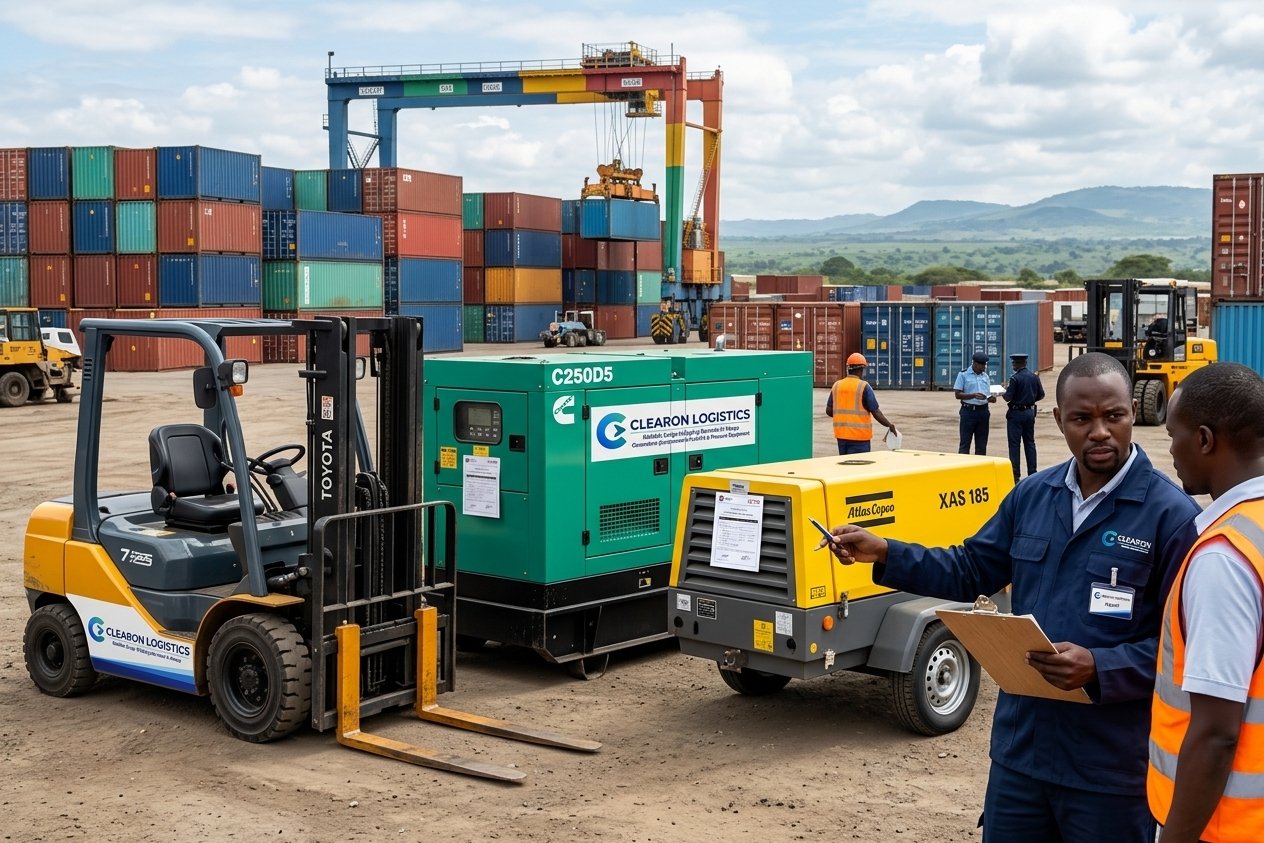
A clearing agent for industrial equipment handles the workhorse machines that keep factories, warehouses, farms and construction sites running: generating sets, compressors, pumps, forklifts, boilers and pressure vessels, welding plant and material-handling gear. It’s a different buyer from the production-line importer in our industrial machinery guide: more units, more used stock, more dealers, and a safety regime that applies after customs clearance, which many importers don’t discover until the machine is already on site.
Table of Contents
What Counts as Industrial Equipment
In practice this means generating sets, air compressors and pumps, forklifts and pallet trucks, cranes and hoists, boilers and pressure vessels, welding and cutting plant, and industrial heating and cooling plant. These fall mostly in HS chapters 84 and 85, but the exact heading depends on the product, power rating and use, so classification should be settled per model, not per shipment. Our HS code guide explains why that single step drives duty, permits and speed.
New and Used Equipment, and the Valuation Question
A great deal of this equipment arrives second-hand. Kenya has no published blanket age limit for general machinery like the 8-year vehicle rule, but used units attract valuation scrutiny, so keep purchase records, a condition report and, for higher-value items, independent valuation support. Our used machinery guide covers this in depth. Carriers usually also impose their own conditions on used equipment, such as drained fuel tanks and disconnected batteries, so confirm those with your forwarder before loading.
Certification and Electrical Considerations
Whether KEBS pre-export verification applies depends on the product, and exemption routes exist for certain manufacturer own-use imports, so confirm per model. Generating sets and any equipment with significant electrical content also raise the points in our electrical equipment guide, including certificate-to-consignment matching and EPR obligations under our EPR guide. Environmental noise rules can apply to how generators and compressors are operated, so check site requirements before you commission.
The Safety Regime That Starts After Clearance
This is the part most equipment importers miss. Under the Occupational Safety and Health Act (OSHA), workplaces and plant are registered, and pressure vessels, boilers, cranes, hoists, forklifts and lifting tackle are subject to statutory examination by examiners approved by the Directorate of Occupational Safety and Health Services, with published fee schedules for each category. Customs clearance doesn’t satisfy any of this. If you import for resale, tell your buyers; if you import for your own use, budget the time for examination before the equipment goes into service, and don’t promise a commissioning date that ignores it.
Logistics: Fit, Fuel and Batteries
Forklifts and compressors may fit in standard or high-cube containers, open-tops or flat-racks, while large generating sets and boilers can be breakbulk; see our bulk and breakbulk guide. Forklift and generator batteries need correct dangerous-goods handling, and lead-acid units carry the environmental obligations described in our battery guide. Plan the road leg around axle load limits, especially for heavy pressure equipment.
Documentation Pack for Industrial Equipment
- Itemised invoice with model, serial number, rating and condition
- Packing list with dimensions and weights per unit
- Bill of Lading, Advance Cargo Declaration reference and Certificate of Origin
- Export declaration document from the country of origin
- Certificate of Conformity or exemption letter where applicable
- For used units: condition report, maintenance history, valuation support
- For pressure and lifting equipment: manufacturer data and test certificates to support later examination
- Local marine cargo insurance certificate
Working With Clearon Logistics on Industrial Equipment
We help dealers and end users confirm classification per model, agree how used units will be valued, arrange certification routes before shipping, and plan delivery to site. We also flag the post-clearance safety obligations early so your commissioning plan is realistic.
Importing generators, compressors, forklifts or pressure equipment? Talk to Clearon Logistics with your equipment list, and we’ll confirm the compliance route for each unit.
Frequently Asked Questions
Is there an age limit for used forklifts or generators in Kenya? There is no published blanket age rule for general machinery, but used equipment attracts valuation scrutiny, so keep records and a condition report.
Does customs clearance mean I can start using a boiler or crane immediately? No. Pressure vessels, cranes, forklifts and other lifting equipment are subject to statutory examination by approved examiners under occupational safety law, which is separate from customs.
Why do carriers ask for drained fuel and disconnected batteries? Fuel and batteries are dangerous-goods concerns in transport, and carriers typically require equipment to be prepared accordingly. Confirm requirements with your forwarder.
Can I classify a generator and its accessories together? It’s safer to itemise them, since the unit, control panels and accessories may classify differently.
Further Reading
- Directorate of Occupational Safety and Health Services (external, dofollow)
- Kenya Bureau of Standards (KEBS) (external, dofollow)
- Related on our blog: Clearing Agent for Industrial Machinery Importers
- Related on our blog: Clearing Agent for Electrical Equipment Importers
- Related on our blog: Importing Used Machinery into Kenya
- Related on our blog: Clearing Agent for Construction Equipment Importers
- Related on our blog: Clearing Agent for Industrial Spare Parts
- Our service: Clearing and Forwarding Services in Kenya


Leave a Reply